The Influence of Perceived Managerialism, Ethical Leadership and Collegial Governance on Relational Governance Culture in Malaysian Higher Education
Keywords:
Collegial governance, ethical leadership, Malaysian universities, perceived managerialism, relational governance culture, Social Exchange TheoryAbstract
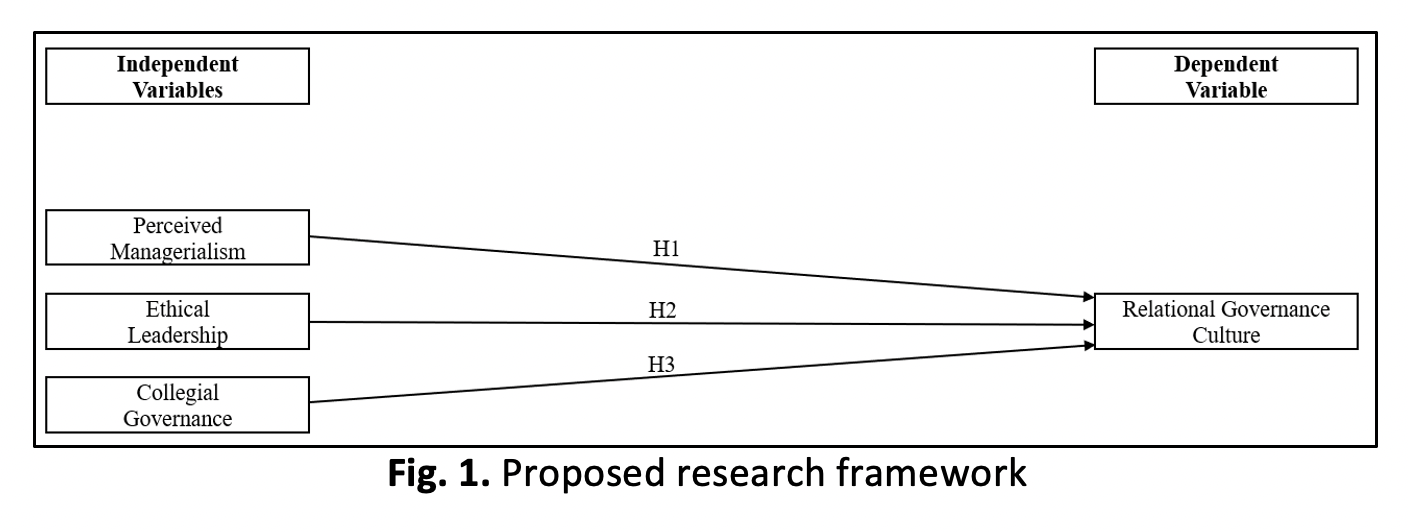
Malaysian higher education institutions operate within an increasingly complex governance environment shaped by global rankings, regulatory oversight, audit cultures, and market competition. Public and private universities are expected to demonstrate measurable performance while preserving academic integrity, collegial traditions, and social responsibility. Such demands have intensified debates about how governance models influence institutional culture. This study is inspired by the lyric of “Ada” by M. Nasir (1993). The line “dalam aku ada Dia, dan dalam Dia ada kita, ada semua”, symbolically reflects layered accountability. Within individual lies moral awareness, and within that awareness resides collective responsibility. From a higher education perspective, governance not just limited to structural compliance, but a moral and relational system grounded in shared accountability. Drawing on Social Exchange Theory (SET), this study examines how perceived managerialism, ethical leadership, and collegial governance influence relational governance culture in Malaysian universities. SET posits that relationships are shaped by reciprocity and perceived fairness. Using a quantitative design, data were collected through stratified non-random sampling from academicians in public and private universities across Malaysia. A total of 412 usable responses were analysed using SPSS 29 and SmartPLS 4.0. The structural model demonstrated strong explanatory power (R² = 0.672). Ethical leadership (β = 0.663, p < 0.001) and perceived managerialism (β = 0.287, p < 0.001) significantly influence relational governance culture, while collegial governance showed no significant direct effect (β = −0.085, p = 0.149. The lyric “dalam aku ada Dia, dan dalam Dia ada kita, ada semua” summarises the philosophical foundation of this study that is “within individual moral realisation lies collective responsibility”. Ethical leadership emerges as the primary driver of a relational governance culture, reinforcing reciprocity, trust, and shared responsibility. Governance in Malaysian higher education, therefore, is not solely about systems and performance metrics only (managerialism) but about moral leadership that nurtures collective commitment and long-term institutional sustainability.