
Causal factors influencing spiritual intelligence in Islamic learning environments among higher education students: A DEMATEL approach

Authors

  • Ramlan Mustapha Academy of Contemporary Islamic Studies, Universiti Teknologi MARA, Kampus Raub Pahang, Malaysia
  • Nurhapizah Mohd Burhan Academy of Contemporary Islamic Studies, Universiti Teknologi MARA, Kampus Jengka Pahang, Malaysia
  • Maziah Mahmud Academy of Contemporary Islamic Studies, Universiti Teknologi MARA, Kampus Jengka Pahang, Malaysia
  • Siti Norma Aisyah Malkan@Molkan Academy of Contemporary Islamic Studies, Universiti Teknologi MARA, Kampus Raub Pahang, Malaysia
  • Nurshahira Ibrahim Academy of Contemporary Islamic Studies, Universiti Teknologi MARA, Kampus Jengka Pahang, Malaysia

Keywords:

Spiritual intelligence, DEMATEL, Islamic higher education, causal analysis, religious education, Islamic learning environment, family religious background, spiritual development

Abstract

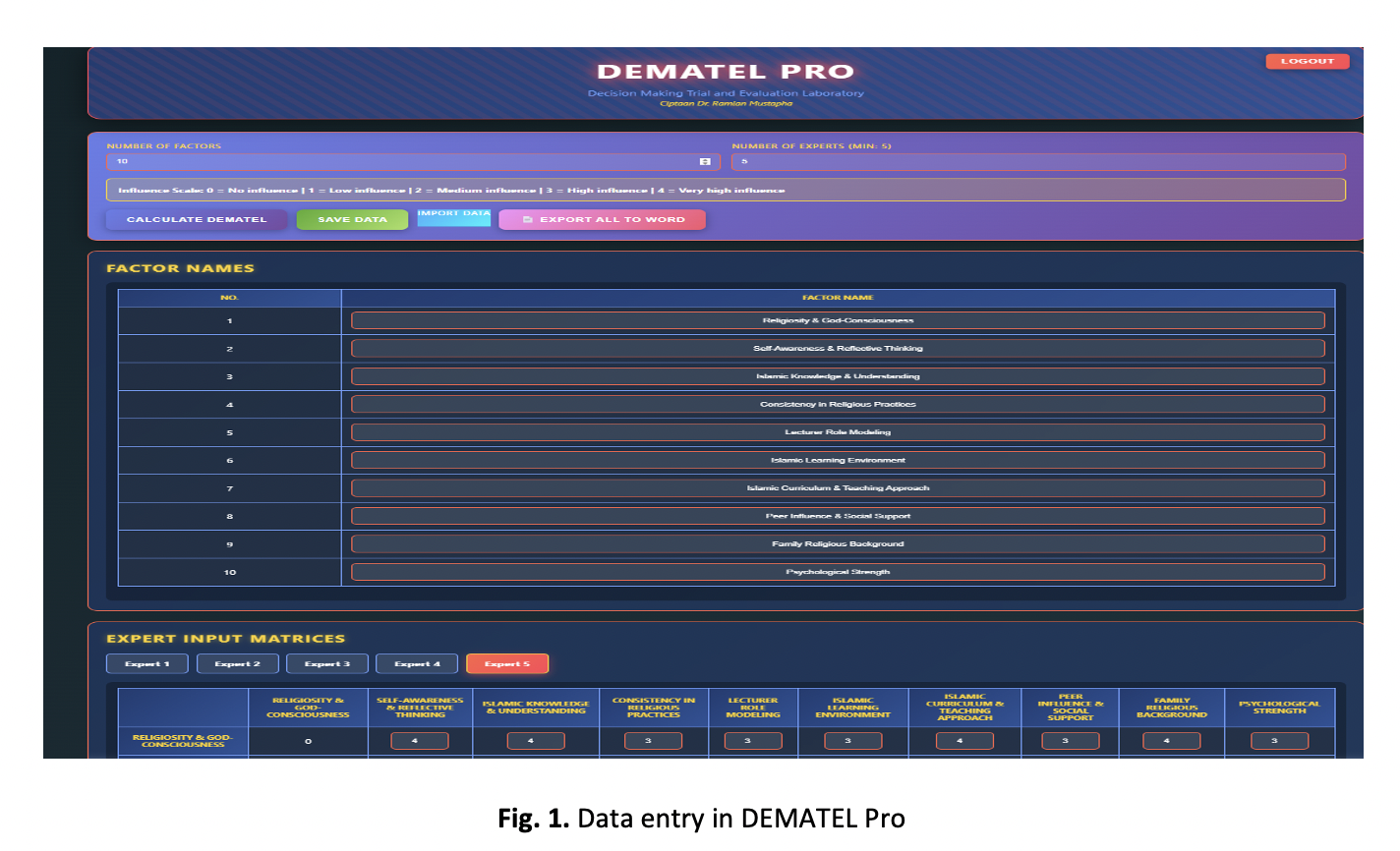
This study investigates the causal factors influencing spiritual intelligence among higher education students in Islamic learning environments, employing the Decision-Making Trial and Evaluation Laboratory (DEMATEL) approach to map complex interdependencies among ten identified factors. Through a systematic literature review grounded in classical Islamic scholarship and contemporary educational psychology, ten key factors were identified: Religiosity & God-Consciousness, Self-Awareness & Reflective Thinking, Islamic Knowledge & Understanding, Consistency in Religious Practices, Lecturer Role Modeling, Islamic Learning Environment, Islamic Curriculum & Teaching Approach, Peer Influence & Social Support, Family Religious Background, and Psychological Strength. Data were collected from five domain experts with extensive experience in Islamic education, and the DEMATEL procedure was applied using DEMATEL Pro Software to compute the normalized direct-relation matrix, the total-relation matrix, and the cause-effect classifications. The findings reveal that six factors Islamic Knowledge & Understanding, Family Religious Background, Peer Influence & Social Support, Self-Awareness & Reflective Thinking, Psychological Strength, and Islamic Curriculum & Teaching Approach function as cause factors, while four factors Religiosity & God-Consciousness, Consistency in Religious Practices, Lecturer Role Modeling, and Islamic Learning Environment operate as effect factors. Islamic Knowledge & Understanding and Family Religious Background emerged as the most dominant causal drivers, each recording the highest positive ri − ci value of 0.85, while Lecturer Role Modeling was identified as the most dependent effect factor (ri − ci = −1.42). These findings provide a structured causal framework that can inform curriculum design, pedagogical strategies, and policy interventions aimed at enhancing spiritual intelligence development in Islamic higher education contexts.

Author Biographies

Ramlan Mustapha, Academy of Contemporary Islamic Studies, Universiti Teknologi MARA, Kampus Raub Pahang, Malaysia

ramlan@uitm.edu.my

Nurhapizah Mohd Burhan, Academy of Contemporary Islamic Studies, Universiti Teknologi MARA, Kampus Jengka Pahang, Malaysia

izahuiaum@uitm.edu.my

Maziah Mahmud, Academy of Contemporary Islamic Studies, Universiti Teknologi MARA, Kampus Jengka Pahang, Malaysia

maziahmahmud@uitm.edu.my

Siti Norma Aisyah Malkan@Molkan, Academy of Contemporary Islamic Studies, Universiti Teknologi MARA, Kampus Raub Pahang, Malaysia

siti_norma@uitm.edu.my

Nurshahira Ibrahim, Academy of Contemporary Islamic Studies, Universiti Teknologi MARA, Kampus Jengka Pahang, Malaysia

shahiraibrahim@uitm.edu.my

Downloads

Published

2026-06-24

Issue

Section

Articles