Learning Style Preferences of Diploma Students in Multimedia Interactive Courses: A VARK-Based Study of Computer Science and Statistics Programmes

Authors

  • Saffa Raihan Zainal Abidin Faculty of Computing and Mathematical Sciences, Universiti Teknologi MARA, Cawangan Pahang, Raub Campus, 27600 Raub, Pahang, Malaysia
  • Halimatun Saadiah Abd Mutalib Academy of Language Studies, Universiti Teknologi MARA, Cawangan Seri Iskandar, Perak Campus, 32610 Seri Iskandar, Perak, Malaysia
  • Rozeleenda Abdul Rahman Faculty of Computing and Mathematical Sciences, Universiti Teknologi MARA, Cawangan Pahang, Raub Campus, 27600 Raub, Pahang, Malaysia
  • Nursyahida Mokhtar Faculty of Computing and Multimedia, Universiti Poly-Tech Malaysia
  • Nor Zalina Ismail Faculty of Computing and Mathematical Sciences, Universiti Teknologi MARA, Cawangan Pahang, Raub Campus, 27600 Raub, Pahang, Malaysia
  • Mohd Rizal Razak Faculty of Computing and Mathematical Sciences, Universiti Teknologi MARA, Cawangan Pahang, Raub Campus, 27600 Raub, Pahang, Malaysia

Keywords:

learning styles, multimedia interactive learning, VARK model, diploma students, teaching strategies

Abstract

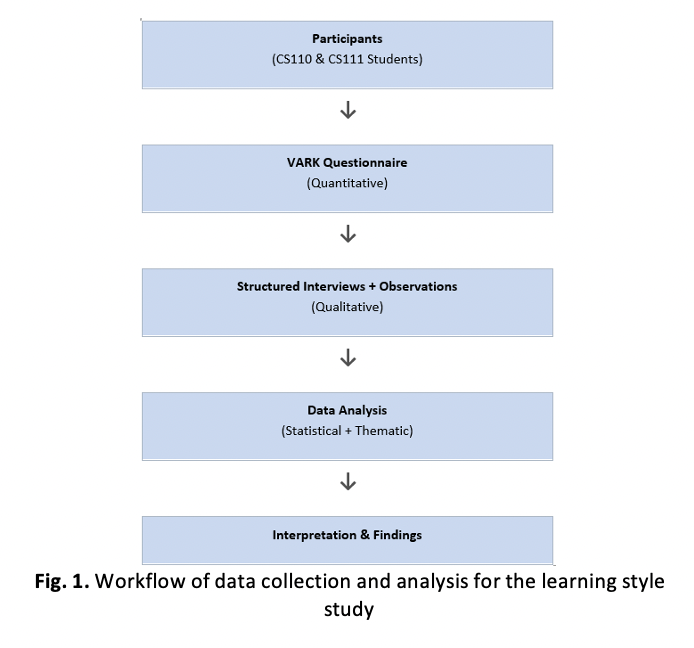
Understanding students’ learning preferences is important for designing effective instructional strategies, especially in courses that integrate visual, verbal, textual, and practical elements. This study investigates the learning style preferences of diploma students enrolled in the Multimedia Interactive course (CSC253) at Universiti Teknologi MARA Cawangan Pahang, Kampus Raub. It aims to identify the dominant learning styles of students from the CS110 and CS111 programmes using Fleming’s VARK model and to examine the implications for teaching and learning. The study offers context-specific evidence on learning preferences among Malaysian diploma students in computer-related programmes, a population that has received limited attention in previous VARK-based studies. A descriptive mixed-methods design was employed, combining quantitative data from an adapted VARK questionnaire with qualitative data from structured interviews and classroom observations. A total of 150 students participated. The results indicate that visual learning was the dominant preference, followed by kinaesthetic learning, with a substantial proportion of students also demonstrating multimodal preferences. These findings suggest that students benefit from diverse instructional approaches rather than a single mode of delivery. The study concludes that multimedia interactive courses should adopt flexible and inclusive teaching strategies that integrate visual materials, guided discussion, written support, and hands-on activities to strengthen student engagement and learning outcomes.

Author Biography

Saffa Raihan Zainal Abidin, Faculty of Computing and Mathematical Sciences, Universiti Teknologi MARA, Cawangan Pahang, Raub Campus, 27600 Raub, Pahang, Malaysia

saffaraihan@uitm.edu.my

Downloads

Published

2026-06-25

Issue

Section

Articles