
A DEMATEL-Based Model for Understanding Bullying Factors Among Orang Asli Pupils in Malaysia

Authors

  • Shamsinar Rahman Faculty of Administrative Science and Policy Studies, Universiti Teknologi MARA Pahang, Raub Campus, Malaysia
  • Suria Fadhillah Md Pauzi Faculty of Law, Universiti Teknologi MARA Pahang, Raub Campus, Malaysia
  • Mohamad Sahizam Musa Faculty of Administrative Science and Policy Studies, Universiti Teknologi MARA Pahang, Raub Campus, Malaysia
  • Mohd Azim Zainal Faculty of Computer and Mathematical Sciences, Universiti Teknologi MARA Pahang, Raub Campus, Malaysia
  • Ida Rosnita Ismail UKM-Graduate School of Business, Universiti Kebangsaan Malaysia

Keywords:

orang Asli, students, DEMATEL

Abstract

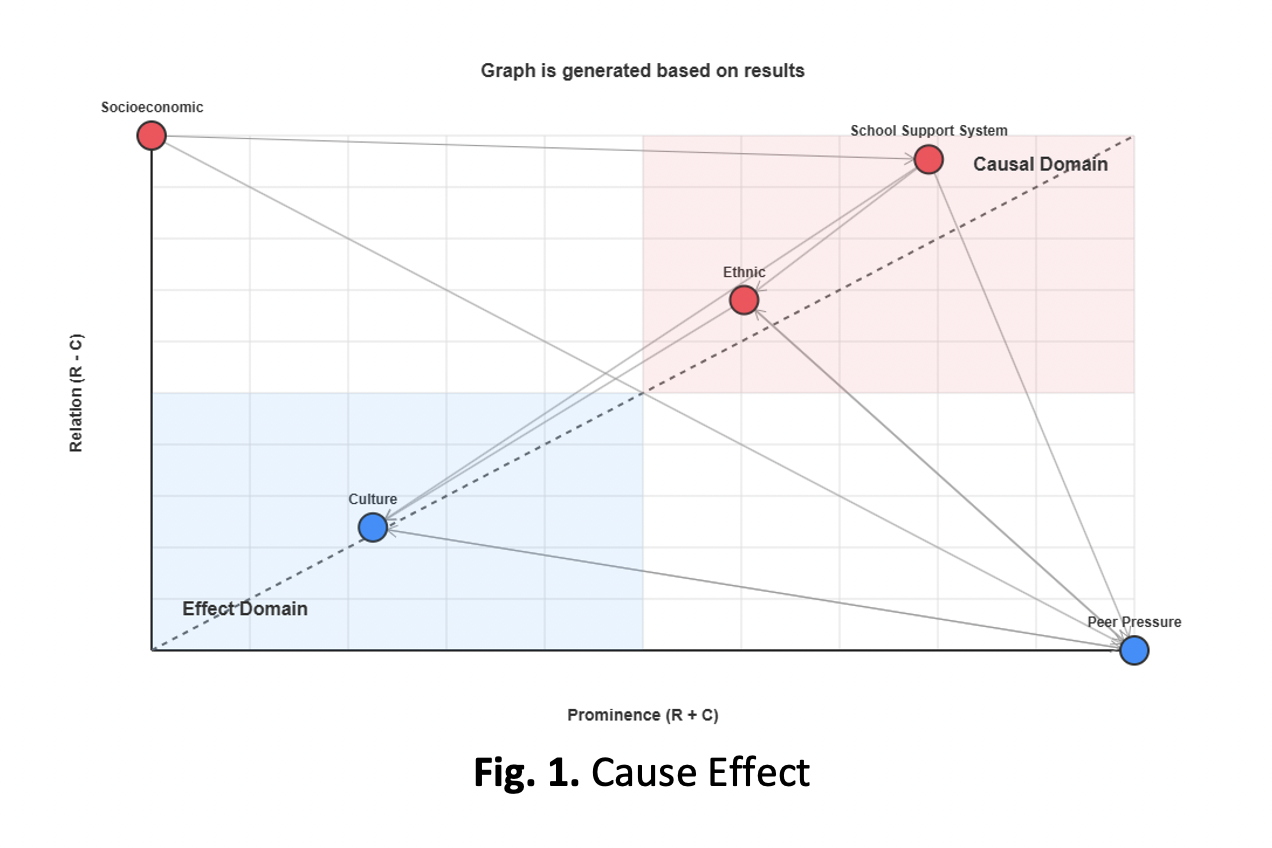
Bullying within Orang Asli primary schools in Malaysia represents a complex socio-educational dilemma. While ethnic disparities, cultural friction, and socioeconomic disadvantages are recognized as contributing factors to student vulnerability, existing research remains fragmented. Most studies examine risk factors in isolation, failing to account for the systemic interdependencies that drive bullying dynamics within indigenous communities. Consequently, there is a critical need for an integrated approach to understand how these multifaceted elements interact to influence social safety. This study aims to develop a causal model to analyze the factors influencing bullying dynamics among Orang Asli pupils, focusing on five key dimensions: ethnic, cultural, socioeconomic, peer pressure, and the school support system. To achieve this, the study employs the Decision-Making Trial and Evaluation Laboratory (DEMATEL) method. This approach utilizes expert evaluations to identify cause and effect relationships and determine the relative influence of each factor within the ecosystem. The findings reveal a highly interconnected system where peer pressure is the most prominent factor but functions as a systemic outcome. Conversely, the school support system and socioeconomic conditions emerge as the primary causal drivers. These results indicate that bullying is a structural phenomenon, where institutional quality and socioeconomic stability serve as the root regulators that shape the cultural environment and peer dynamics for Orang Asli pupils. In conclusion, this research demonstrates that bullying among Orang Asli pupils is a multifaceted phenomenon driven by the complex interplay of social, cultural, and institutional forces. Methodologically, the study provides a data-driven framework for prioritizing interventions based on a causal hierarchy of risk factors. By elucidating these interrelationships, the research fills critical gaps in the understanding of indigenous social dynamics and educational policy, offering a strategic model for fostering inclusive and safe learning environments in marginalized contexts.

Author Biographies

Shamsinar Rahman, Faculty of Administrative Science and Policy Studies, Universiti Teknologi MARA Pahang, Raub Campus, Malaysia

shamsinar512@uitm.edu.my

Suria Fadhillah Md Pauzi, Faculty of Law, Universiti Teknologi MARA Pahang, Raub Campus, Malaysia

suriapauzi@uitm.edu.my

Mohamad Sahizam Musa, Faculty of Administrative Science and Policy Studies, Universiti Teknologi MARA Pahang, Raub Campus, Malaysia

msahizam@uitm.edu.my

Mohd Azim Zainal, Faculty of Computer and Mathematical Sciences, Universiti Teknologi MARA Pahang, Raub Campus, Malaysia

azim90@uitm.edu.my

Ida Rosnita Ismail, UKM-Graduate School of Business, Universiti Kebangsaan Malaysia

idarosnita@ukm.edu.my

Downloads

Published

2026-06-25

Issue

Section

Articles