Analysis of Causal Interrelationships of Digital Translation Tool Usage in Arabic Language Learning: A DEMATEL Approach

Authors

  • Maimanah Samsuri Akademi Pengajian Bahasa, Universiti Teknologi MARA, Cawangan Pahang, Kampus Raub, Felda Krau, 27600 Raub, Pahang, Malaysia
  • Siti Aisyah Mazlan Akademi Pengajian Bahasa, Universiti Teknologi MARA, Cawangan Pahang, Kampus Raub, Felda Krau, 27600 Raub, Pahang, Malaysia
  • Mazni Muslim Akademi Pengajian Bahasa, Universiti Teknologi MARA, Cawangan Pahang, Kampus Raub, Felda Krau, 27600 Raub, Pahang, Malaysia
  • Nurma Abdul Manap Akademi Pengajian Bahasa, Universiti Teknologi MARA, Cawangan Pahang, Kampus Raub, Felda Krau, 27600 Raub, Pahang, Malaysia

Keywords:

Arabic Language Learning, DEMATEL Approach, Digital Translation Tool, Interrelationships

Abstract

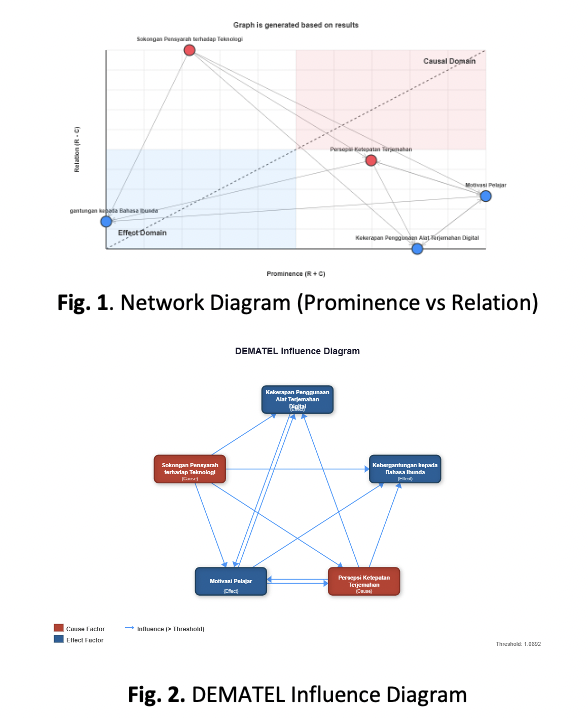
This study examines the advancement of digital technology that is transforming language learning approaches, specifically the application of digital translation tools in Arabic language education. Nonetheless, uncertainty persists regarding the impact of specific factors on the effective utilization of this tool. Therefore, this study highlights the importance of understanding the causal relationships between factors that impact the use of digital translation tools in the acquisition of Arabic language by students. In addition to analysing five main factors, namely the frequency of using digital translation tools, reliance on the native language, perception of translation accuracy, student motivation, and lecturer support for technology. The research methodology involved using the DEMATEL method to analyse cause-and-effect relationships by utilising the direct-relation matrix, the overall-relation matrix, and the normalized matrix. Data were obtained through interviews and a 0–4 scale questionnaire involving five experts in the relevant field. The study findings indicate that lecturer support is the dominant factor influencing other factors, while the perception of translation accuracy acts as an initial trigger. On the other hand, student motivation, frequency of use, and reliance on the mother tongue are the resulting factors. In conclusion, the effectiveness of technology use in language learning depends on the guidance of lecturers and the role of educational institutions in enhancing the digital skills of both lecturers and students. Future research needs to examine the impact of digital tool usage on the long-term development of writing skills.

Author Biographies

Siti Aisyah Mazlan, Akademi Pengajian Bahasa, Universiti Teknologi MARA, Cawangan Pahang, Kampus Raub, Felda Krau, 27600 Raub, Pahang, Malaysia

sitiaisyah370@uitm.edu.my

Mazni Muslim, Akademi Pengajian Bahasa, Universiti Teknologi MARA, Cawangan Pahang, Kampus Raub, Felda Krau, 27600 Raub, Pahang, Malaysia

maznimus@uitm.edu.my

Nurma Abdul Manap, Akademi Pengajian Bahasa, Universiti Teknologi MARA, Cawangan Pahang, Kampus Raub, Felda Krau, 27600 Raub, Pahang, Malaysia

nurma@uitm.edu.my

Downloads

Published

2026-06-25

Issue

Section

Articles