
The DEMATEL Approach in Evaluating the Dynamics of Zakat Payment Factors

Authors

  • Surita Hartini Mat Hassan Akademi Pengajian Islam Kontemporari, Universiti Teknologi MARA, Cawangan Pahang, Kampus Raub, Raub, Pahang, Malaysia
  • Mohd Nasir Ayub Akademi Pengajian Islam Kontemporari, Universiti Teknologi MARA, Cawangan Pahang, Kampus Raub, Raub, Pahang, Malaysia
  • Sakinatul Raadiyah Abdullah Akademi Pengajian Islam Kontemporari, Universiti Teknologi MARA, Cawangan Pahang, Kampus Raub, Raub, Pahang, Malaysia
  • Mohd Faizal P. Rameli Akademi Pengajian Islam Kontemporari, Universiti Teknologi MARA, Cawangan Pahang, Kampus Raub, Raub, Pahang, Malaysia
  • Mohamad Nasrul Hakim Roslan Akademi Pengajian Islam Kontemporari, Universiti Teknologi MARA, Cawangan Pahang, Kampus Raub, Raub, Pahang, Malaysia
  • Muhamad Hafis Mohd Hussain Akademi Pengajian Islam Kontemporari, Universiti Teknologi MARA, Cawangan Pahang, Kampus Raub, Raub, Pahang, Malaysia

Keywords:

Zakat, DEMATEL, institutional trust, religiosity, zakat literacy

Abstract

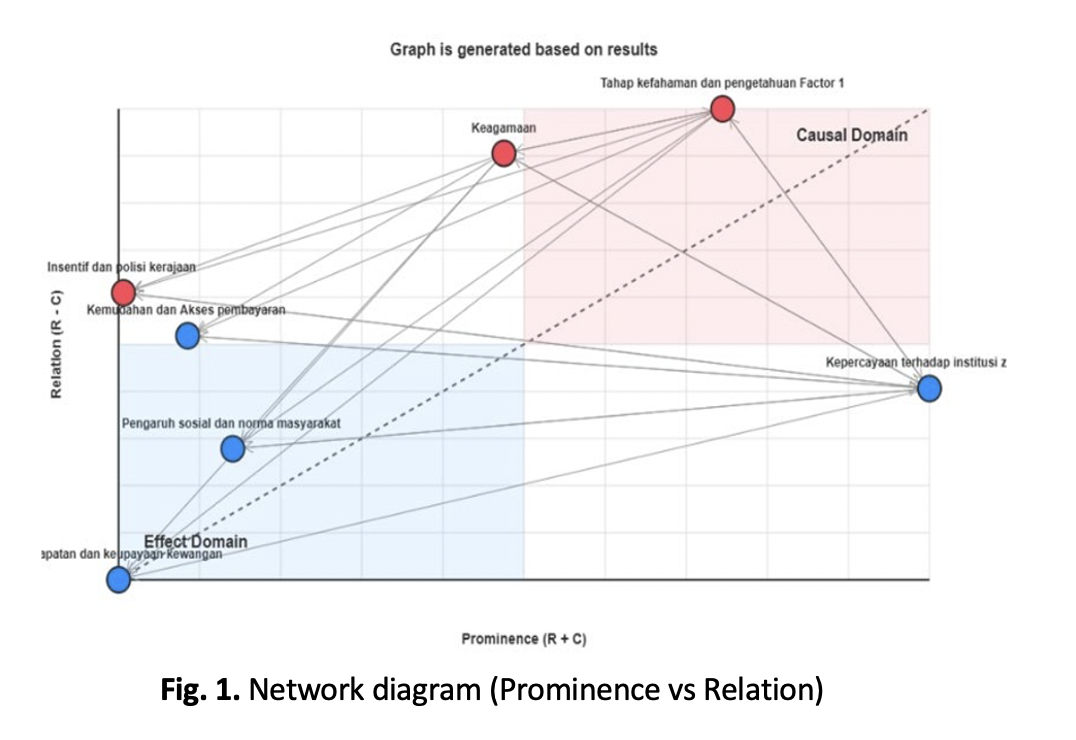
This research is designed to investigate and analyse the factors that affect the behaviour towards making zakat contribution from society via the Decision- Making Trial and Evaluation Laboratory (DEMATEL). The quantitative research method was adopted through engaging five experts in the field of zakat and Islamic financing in examining the relationship between seven factors; these include level of understanding and knowledge, religiosity, income and financial capacity, trust in zakat-related institutions, payment ease and accessibility, social influences and norms, as well as government policies and incentives. It was found that the three factors of level of understanding and knowledge, religiosity, and government policies and incentives belong to the cause factors because they drive the process. Meanwhile, the rest of the factors, such as trust in zakat-related institutions, income and financial capacity, payment ease and accessibility, as well as social influences are classified into the effect factors that are affected by other factors. More importantly, the trust in zakat institutions is the most prominent factor among all factors considered in this study. It is recommended that a holistic approach be taken where education and religion  play  major roles  while government  policies  should  be strengthened.

Author Biographies

Surita Hartini Mat Hassan, Akademi Pengajian Islam Kontemporari, Universiti Teknologi MARA, Cawangan Pahang, Kampus Raub, Raub, Pahang, Malaysia

Mohd Nasir Ayub, Akademi Pengajian Islam Kontemporari, Universiti Teknologi MARA, Cawangan Pahang, Kampus Raub, Raub, Pahang, Malaysia

mnasir251@uitm.edu.my

Sakinatul Raadiyah Abdullah, Akademi Pengajian Islam Kontemporari, Universiti Teknologi MARA, Cawangan Pahang, Kampus Raub, Raub, Pahang, Malaysia

sakinatulraadiyah@uitm.edu.my

Mohd Faizal P. Rameli, Akademi Pengajian Islam Kontemporari, Universiti Teknologi MARA, Cawangan Pahang, Kampus Raub, Raub, Pahang, Malaysia

faizal061@uitm.edu.my

Mohamad Nasrul Hakim Roslan, Akademi Pengajian Islam Kontemporari, Universiti Teknologi MARA, Cawangan Pahang, Kampus Raub, Raub, Pahang, Malaysia

nasrulhakim@uitm.edu.my

Muhamad Hafis Mohd Hussain, Akademi Pengajian Islam Kontemporari, Universiti Teknologi MARA, Cawangan Pahang, Kampus Raub, Raub, Pahang, Malaysia

hafishussain@uitm.edu.my

Downloads

Published

2026-07-02

Issue

Section

Articles