Malaysia’s Ageing Population: A Demographic Perspective

Authors

  • Saharani Abdul Rashid School of Mathematical Sciences, Faculty of Computer and Mathematical Sciences, Universiti Teknologi Mara, 27600 Raub, Pahang, Malaysia
  • Mazura Mokhtar School of Mathematical Sciences, Faculty of Computer and Mathematical Sciences, Universiti Teknologi Mara, 27600 Raub, Pahang, Malaysia
  • Norshahida Shaadan Center of Mathematical Sciences, Faculty of Computer and Mathematical Sciences, Universiti Teknologi Mara, 40000 Shah Alam, Selangor, Malaysia

Keywords:

Demographic transition, elderly population, population ageing, socio-economic implications

Abstract

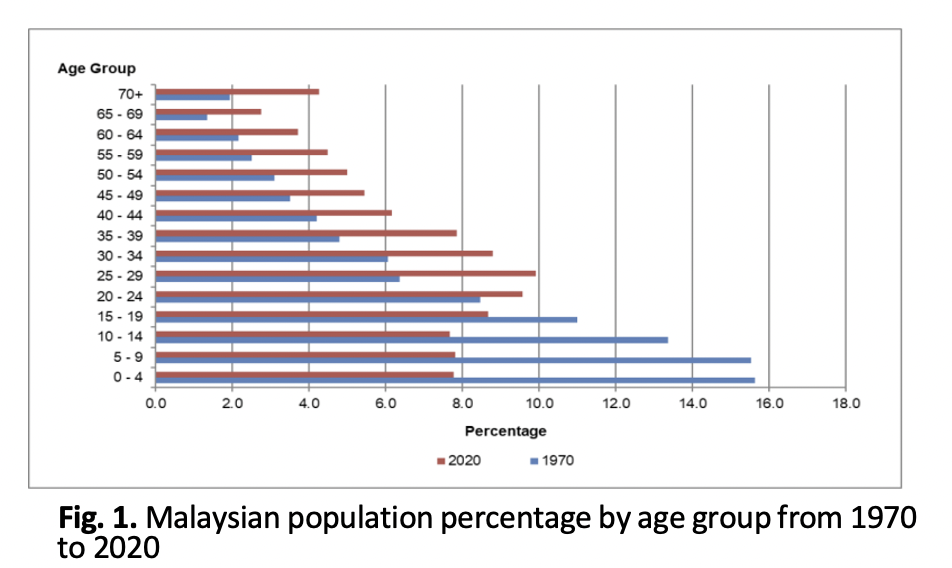
Malaysia is currently undergoing a significant demographic transition characterised by a rapid increase in population ageing. Such shift is fundamentally driven by the sustained declines in both fertility and mortality alongside continued improvements in life expectancy across the population. This study examines the historical and contemporary trends of population ageing in Malaysia using secondary data obtained from the Department of Statistics Malaysia (DOSM) and other national agencies. Descriptive statistics were employed to investigate shifts in age structure, dependency ratios, sex composition, and ethnic distribution. The findings demonstrate a steady increase in the proportion of older adults, with the population aged 60 and above rising from 5.4% in 1970 to 9.7% in 2020 and is projected to exceed 16% by 2040. The ageing index and old-age dependency ratio have also showed substantial growth, indicating mounting socioeconomic and health-related demands. Furthermore, disparities across ethnic groups highlight important demographic nuances. These findings indicate that Malaysia’s transition towards an ageing society is occurring more rapidly than the trajectories historically observed in numerous developed nations. Such demographic transitions have critical implications for healthcare provisioning, labour market sustainability, social support systems, and long-term policy planning. Strengthening integrated ageing policies, expanding geriatric care, enhancing social protection mechanisms, and promoting active ageing are essential to ensure a resilient and inclusive response to Malaysia’s evolving demographic landscape.

Author Biography

Saharani Abdul Rashid, School of Mathematical Sciences, Faculty of Computer and Mathematical Sciences, Universiti Teknologi Mara, 27600 Raub, Pahang, Malaysia

Downloads

Published

2026-07-02

Issue

Section

Articles