
Using DEMATEL to Analyse the Causal Factors Influencing Students’ Low Participation in Co-Curricular Activities in Higher Education Institutions in Malaysia

Authors

  • Nurma Abdul Manap Akademi Pengajian Bahasa, Universiti Teknologi MARA, Cawangan Pahang Kampus Raub, 27600 Raub, Pahang, Malaysia
  • Mazni Muslim Akademi Pengajian Bahasa, Universiti Teknologi MARA, Cawangan Pahang Kampus Raub, 27600 Raub, Pahang, Malaysia
  • Maimanah Samsuri Akademi Pengajian Bahasa, Universiti Teknologi MARA, Cawangan Pahang Kampus Raub, 27600 Raub, Pahang, Malaysia
  • Siti Aisyah Mazlan Akademi Pengajian Bahasa, Universiti Teknologi MARA, Cawangan Pahang Kampus Raub, 27600 Raub, Pahang, Malaysia

Keywords:

Causal relationship, co-curricular activities, DEMATEL, Malaysian Higher Education, institutional barriers, student engagement, soft skills

Abstract

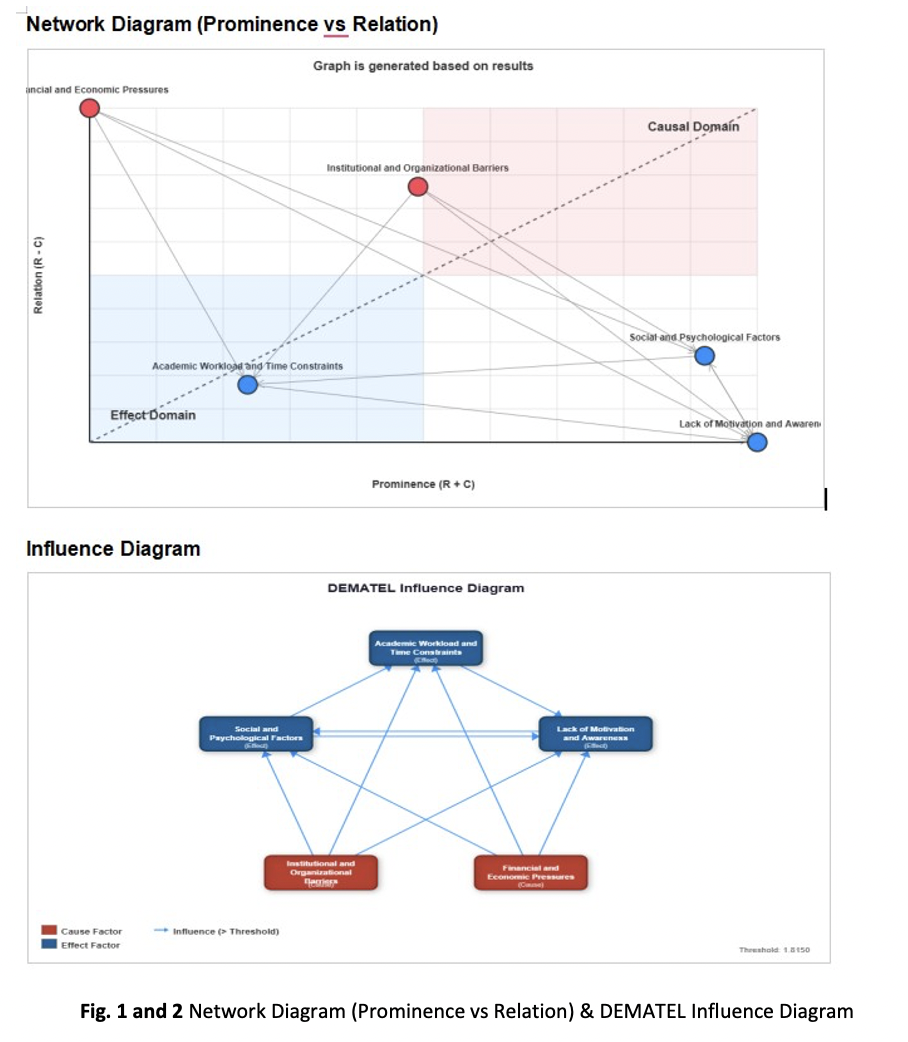
This study examines the persistent issue of low student involvement in co-curricular activities (CCAs) at Malaysian Higher Education Institutions (HEIs). Despite the recognised importance of CCAs in developing "soft skills" and enhancing graduates’ employability, the participation rate among students stands at only 54%. The objective of this research is to transcend mere symptomatic observations and elucidate the intricate causal relationships among institutional, academic, personal, and social barriers. The Decision-Making Trial and Evaluation Laboratory (DEMATEL) method is employed to observe the relationships between five major barriers: academic workload and time constraints, lack of motivation and awareness, financial and economic pressures, institutional and organizational barriers, and social and psychological factors. This method turns qualitative expert evaluations into a quantitative structural model and a causal diagram. The main "Cause Factors" in the system, as identified in the key findings, are Financial and Economic Pressures and Institutional and Organizational Barriers. On the other hand, Lack of Motivation and Awareness emerged as the predominant factor contributing to the effects, indicating underlying structural issues rather than distinct causes. The analysis reveals that institutional inefficiencies and financial constraints contribute to students feeling overwhelmed with work and diminish their intrinsic motivation. The results of this study point to a major change in how Malaysia approaches education. To truly get more people involved, HEIs need to focus on top-down structural changes, such as better scheduling for administrative tasks and more financial support, instead of just student-centered psychological interventions. To make sure that graduates are well-rounded and to close the skills gap in the Malaysian workforce, it is important to address these causal anchors.

Author Biographies

Nurma Abdul Manap, Akademi Pengajian Bahasa, Universiti Teknologi MARA, Cawangan Pahang Kampus Raub, 27600 Raub, Pahang, Malaysia

maznimus@uitm.edu.my

Mazni Muslim, Akademi Pengajian Bahasa, Universiti Teknologi MARA, Cawangan Pahang Kampus Raub, 27600 Raub, Pahang, Malaysia

maznimus@uitm.edu.my

Maimanah Samsuri, Akademi Pengajian Bahasa, Universiti Teknologi MARA, Cawangan Pahang Kampus Raub, 27600 Raub, Pahang, Malaysia

maimanah@uitm.edu.my

Siti Aisyah Mazlan, Akademi Pengajian Bahasa, Universiti Teknologi MARA, Cawangan Pahang Kampus Raub, 27600 Raub, Pahang, Malaysia

sitiaisyah370@uitm.edu.my

Downloads

Published

2026-07-03

Issue

Section

Articles