
Ethical Issues and Challenges of Artificial Intelligence (AI) in TVET Teaching towards Enhancing Student Competences

Authors

  • Nik Nurul Hazirah Hasmadi Faculty of Technical and Vocational, Sultan Idris Education University, Tanjong Malim, 35900, Perak, Malaysia
  • Alya Nabihah Adnan Faculty of Technical and Vocational, Sultan Idris Education University, Tanjong Malim, 35900, Perak, Malaysia
  • Nurul Faesuhaila Ab Rahman Faculty of Technical and Vocational, Sultan Idris Education University, Tanjong Malim, 35900, Perak, Malaysia
  • Tuan Nur Nazifa Tuan Azlin Faculty of Technical and Vocational, Sultan Idris Education University, Tanjong Malim, 35900, Perak, Malaysia
  • Nur Ainfatihah Shaharin Faculty of Technical and Vocational, Sultan Idris Education University, Tanjong Malim, 35900, Perak, Malaysia
  • Rushida Mohd Shahril Rizal Faculty of Technical and Vocational, Sultan Idris Education University, Tanjong Malim, 35900, Perak, Malaysia
  • Mohamed Nor Azhari Azman Faculty of Technical and Vocational, Sultan Idris Education University, Tanjong Malim, 35900, Perak, Malaysia
  • Fardila Mohd Zaihidee Faculty of Technical and Vocational, Sultan Idris Education University, Tanjong Malim, 35900, Perak, Malaysia

Keywords:

Artificial intelligence, TVET, ethics, challenges, student competency

Abstract

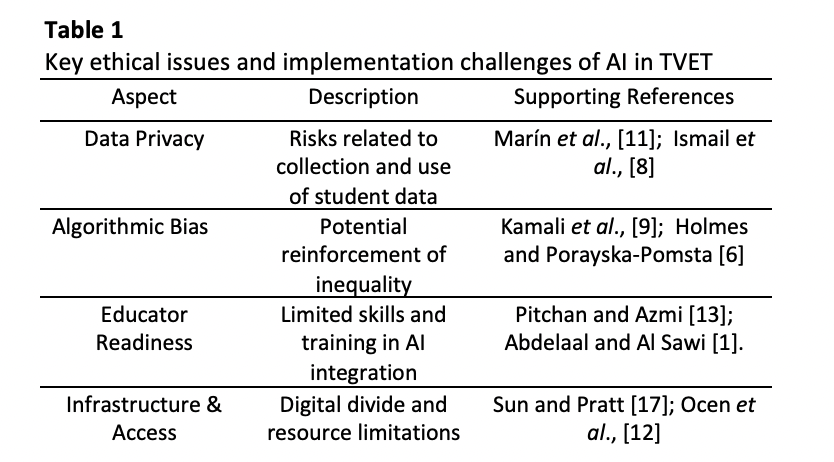
This study aims to conduct a Systematic Literature Review (SLR) on the ethical issues and challenges of artificial intelligence (AI) implementation in Teaching and Learning within Technical and Vocational Education and Training (TVET), as well as its implications for enhancing student competencies. A total of 20 Scopus-indexed articles published between 2022 and 2025 were analysed using a thematic synthesis approach. The article search and initial screening processes were supported by the AI-based research tool Elicit, while the thematic analysis and synthesis were conducted manually to ensure academic rigour. The findings indicate that AI has strong potential to enhance TVET student competencies, particularly in technical skills, self-directed learning, and critical thinking. However, significant challenges remain, including data privacy concerns, algorithmic bias, information security risks, and the readiness of educators and institutional infrastructure. Although several reviewed studies focus on higher education contexts, their findings are considered transferable to TVET settings due to similarities in pedagogical structures, competency-based assessment, and digital learning environments.

Downloads

Published

2026-07-08

Issue

Section

Articles