
The Relationship between Knowledge and Pattern Drafting Skills and Mastery of Calculation Techniques in Garment Pattern Making among Fashion Student

Authors

  • Arasinah Kamis Faculty of Technical & Vocational, Universiti Pendidikan Sultan Idris, Tanjung Malim, Malaysia
  • Farah Najwa Ahmad Puad Faculty of Technical & Vocational, Universiti Pendidikan Sultan Idris, Tanjung Malim, Malaysia
  • Adhi Kusumastuti Faculty of Engineering, Universitas Negeri Semarang, Semarang, Indonesia
  • Adhi Kusumastuti Faculty of Engineering, Universitas Negeri Semarang, Semarang, Indonesia
  • Maspiyah Faculty of Engineering, Universitas Negeri Surabaya, Indonesia
  • Indarti Faculty of Vocational Studies, Universitas Negeri Surabaya
  • Sri Endah Wahyuningsih Faculty of Engineering, Universitas Negeri Semarang, Semarang, Indonesia
  • Mohd Bekri Rahim Faculty of Technical & Vocational Education, Universiti Tun Hussein Onn Malaysia, Malaysia
  • Rahimah Jamaluddin Faculty of Educational Studies, Universiti Putra Malaysia
  • Amira Sufinaz Mohd Zamri Faculty of Technical & Vocational, Universiti Pendidikan Sultan Idris, Tanjung Malim, Malaysia

Keywords:

Home Economics Education, garment pattern making, knowledge of pattern drafting skills, mastery of calculation techniques

Abstract

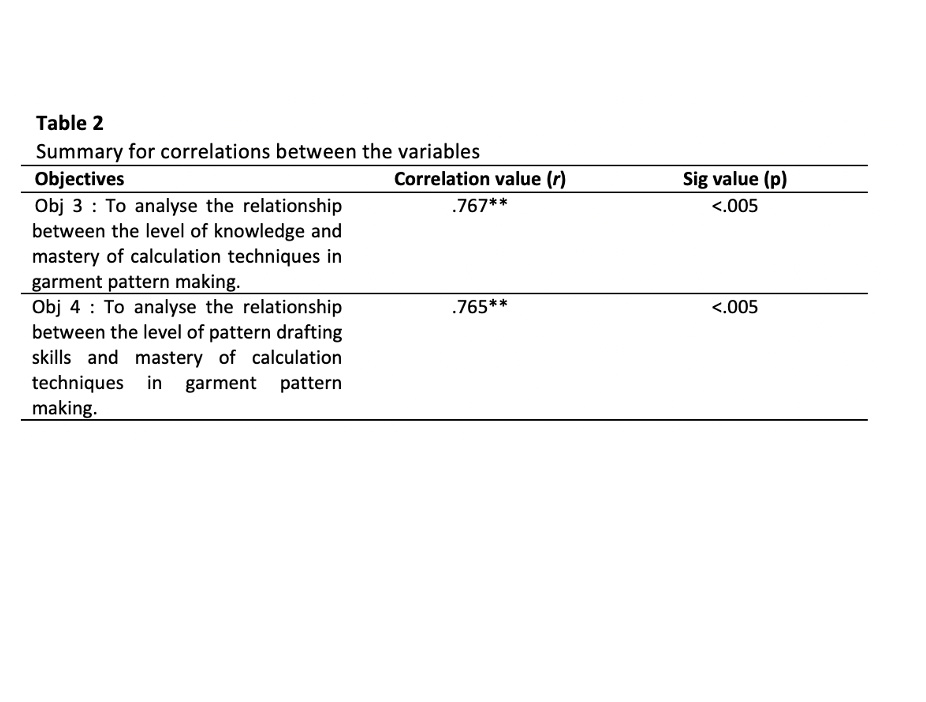
Home Economics Education (HEE) plays an important role in developing technically skilled students in the field of fashion, particularly in garment pattern making, which requires precise calculation skills. However, studies examining the relationship between knowledge, pattern drafting skills, and mastery of calculation techniques among students in Malaysia remain limited. Therefore, this study aims to identify the levels of calculation skills, knowledge, and pattern drafting skills among students, as well as to analyse the relationships between these variables in the context of garment pattern production. This study employed a quantitative approach using a survey research design. A total of 124 students were selected as respondents through stratified random sampling. Data were collected using a questionnaire and analysed using descriptive statistics (mean and standard deviation) and inferential statistics (Pearson correlation) via SPSS software. The findings indicate that pattern drafting skills recorded the highest mean score (M = 3.74, SD = 0.79), followed by knowledge (M = 3.57, SD = 0.75) and mastery of calculation techniques (M = 3.57, SD = 0.76). Pearson correlation analysis revealed a very strong and significant positive relationship between knowledge (r = 0.767, p < 0.005) and pattern drafting skills (r = 0.765, p < 0.005) with mastery of calculation techniques in garment pattern making. The implications of this study highlight the need to strengthen teaching strategies by integrating contextual and practical mathematical elements within the HEE curriculum to enhance students’ technical competencies in line with industry requirements.

Author Biography

Arasinah Kamis, Faculty of Technical & Vocational, Universiti Pendidikan Sultan Idris, Tanjung Malim, Malaysia

arasinah@ftv.upsi.edu.my

Downloads

Published

2026-07-22

Issue

Section

Articles