
Mental Health, Spiritual Intelligence, and Academic Performance among Final-Year Agricultural Education Students in Malaysian Universities

Authors

  • Muhammad Kamal Aiman Baharin Department of Agricultural Science, Faculty of Technical and Vocational, Universiti Pendidikan Sultan Idris, Tanjong Malim, Perak, 35900, Malaysia
  • Asilah Abdul Mutalib Department of Agricultural Science, Faculty of Technical and Vocational, Universiti Pendidikan Sultan Idris, Tanjong Malim, Perak, 35900, Malaysia
  • Zalina Ismail Department of Agricultural Science, Faculty of Technical and Vocational, Universiti Pendidikan Sultan Idris, Tanjong Malim, Perak, 35900, Malaysia
  • Shaibatul ’ Islamiah Che Man Centre of Studies for Landscape Architecture, Faculty of Architecture, Planning and Surveying, Universiti Teknologi MARA, UiTM Puncak Alam, 42300 Puncak Alam, Selangor, Malaysia
  • Fatin Nur Aqmar Ishak Department of Agricultural Science, Faculty of Technical and Vocational, Universiti Pendidikan Sultan Idris, Tanjong Malim, Perak, 35900, Malaysia

Keywords:

Mental health, spiritual intelligence, academic performance

Abstract

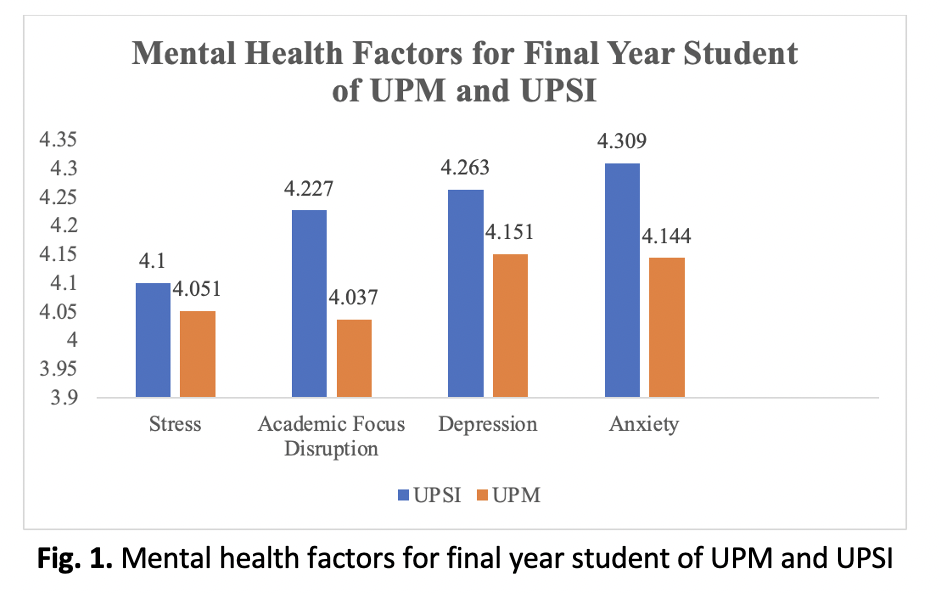
Mental health and spiritual intelligence have emerged as important determinants of students’ academic success in higher education. However, limited empirical evidence exists regarding their combined influence on agricultural education undergraduates in Malaysia. This study examined the relationships between mental health factors, spiritual intelligence, and academic performance among final-year Agricultural Science Education students from two Malaysian public universities. A quantitative cross-sectional survey design was employed, involving 80 final-year students selected through simple random sampling. Data were collected using a structured questionnaire and analysed using descriptive statistics and Pearson correlation analysis with the Statistical Package for the Social Sciences (SPSS). The findings revealed that anxiety recorded the highest mean score among the mental health dimensions, whereas stress showed the lowest mean score. Within the spiritual intelligence construct, the relationship with God demonstrated the highest mean score, followed by relationships with others, religious practices, and life purpose and principles. Correlation analysis indicated that academic focus disruption, depression, and anxiety were significantly associated with academic performance, while stress showed no significant relationship. Furthermore, all dimensions of spiritual intelligence life purpose and principles, religious practices, relationships with others, and relationship with God were positively and significantly associated with academic performance. Among these factors, relationships with others and life purpose and principles exhibited the strongest associations with academic achievement. The study highlights the importance of fostering both psychological well-being and spiritual development to enhance students’ academic outcomes. The findings provide empirical support for the integration of mental health interventions and holistic educational strategies aimed at strengthening students’ resilience, well-being, and academic success in higher education institutions.

Author Biography

Asilah Abdul Mutalib, Department of Agricultural Science, Faculty of Technical and Vocational, Universiti Pendidikan Sultan Idris, Tanjong Malim, Perak, 35900, Malaysia

asilah@ftv.upsi.edu.my

Downloads

Published

2026-07-22

Issue

Section

Articles