Optimizing School Aesthetic Education Governance in the Digital Era: A Conceptual Framework from an Educational Management Perspective
Keywords:
Aesthetic Education, Educational Governance, Digital Transformation, Educational Management, Digital Resources, Teacher DevelopmentAbstract
The digital transformation of education has changed the conditions under which school aesthetic education is organized, delivered, and evaluated. Digital resources, online platforms, artificial intelligence tools, and virtual cultural environments have expanded opportunities for aesthetic learning. However, the development of digital technologies has not always been accompanied by corresponding improvements in school governance. Existing practices indicate that digital resources may remain fragmented, teacher support may be insufficient, and evaluation mechanisms may focus excessively on visible outputs rather than students’ aesthetic development. This study aims to examine how school aesthetic education governance can be optimized in the digital era from an educational management perspective. The study adopts a conceptual literature review approach and analyzes recent studies related to digital transformation in education, aesthetic education, teacher development, and platform governance. Relevant literature was identified through searches of major academic databases, including Web of Science, Scopus, and Google Scholar, using keywords such as “ digital transformation” “ aesthetic education” “ educational governance” “ teacher development” and “ digital platforms” Studies published mainly between 2020
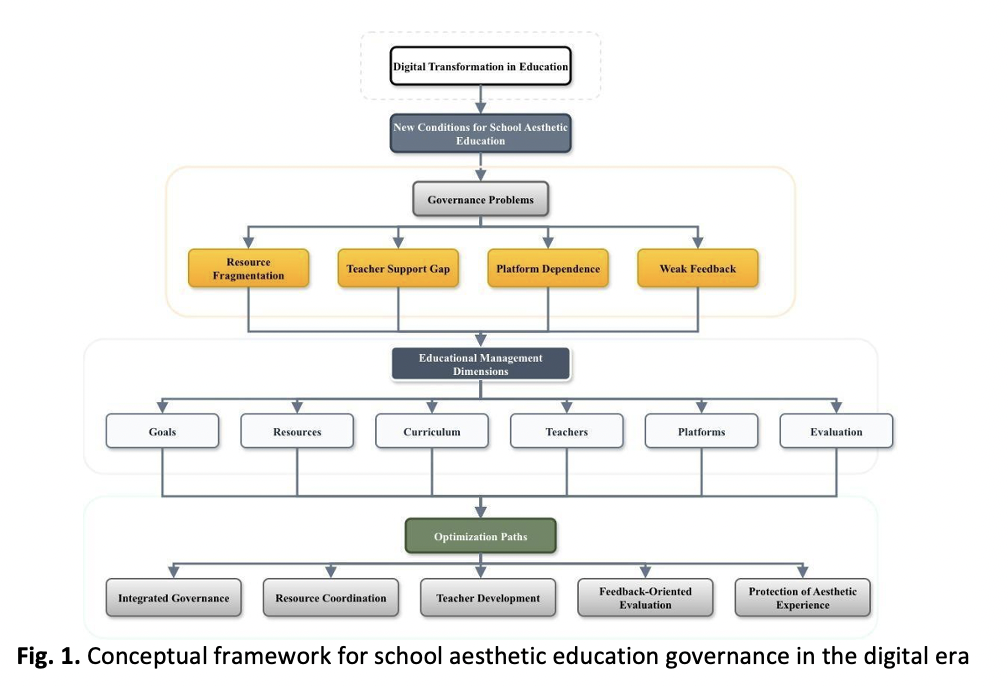
and 2025 were reviewed, with attention given to research addressing digital education management, arts learning, and school governance. The analysis identifies four major governance challenges: fragmented digital resources, uneven teacher support, platform dependence and data formalism, and weak evaluation feedback. Based on these themes, this study proposes an integrated governance framework consisting of six management dimensions: goals, resources, curriculum, teachers, platforms, and evaluation. The framework emphasizes that digital technology should be embedded within a coordinated governance system rather than treated as an independent technical solution. The study contributes to existing research by shifting attention from the application of digital tools in aesthetic education toward the organizational and managerial conditions required for sustainable development. Practically, the proposed framework provides implications for school leaders and policymakers seeking to strengthen digital aesthetic education governance while maintaining the humanistic value of aesthetic experience.