Mapping the Evolution of Monarchy Systems: A Global Bibliometric Analysis
Keywords:
Monarchy systems, Bibliometric analysis, Scientific mapping, Research trends, Thematic evolutionAbstract
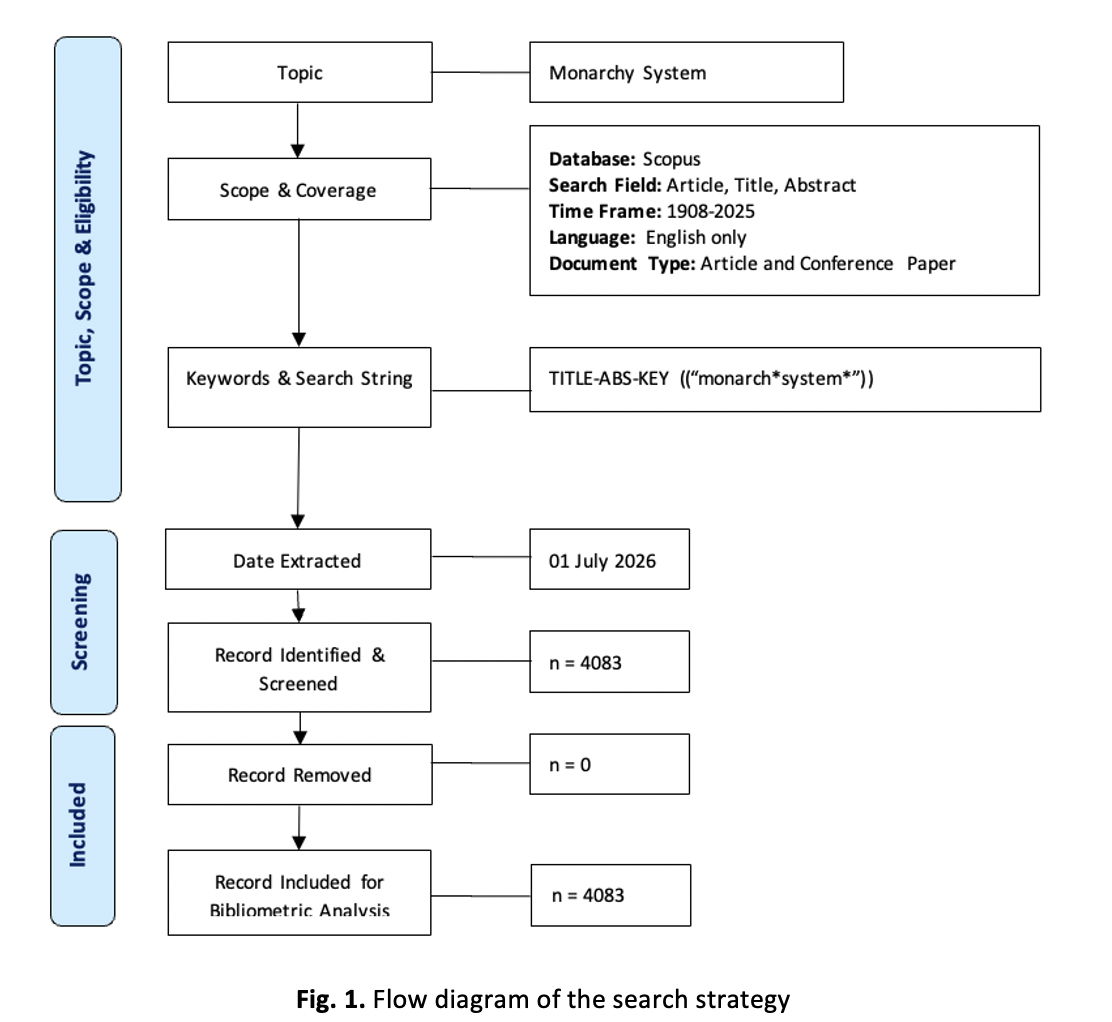
While monarchical systems represent one of the oldest forms of state governance, scholarly literature remains fragmented across regional and historical subdisciplines. This study presents a comprehensive global bibliometric analysis of monarchy system research using a Scopus-retrieved dataset of 4,083 documents published between 1908 and 2025. Employing Biblioshiny (R package) and VOSviewer, this paper evaluates publication growth trajectories, citation performance, key contributors, intellectual network structures, and thematic evolutions. The findings reveal a steady annual growth rate of 5.10 percent, reaching peak scientific output after 2020. Research output is heavily concentrated in Western institutions and high-income nations, led by the United States and the United Kingdom, with limited international collaboration (5.41 percent). Keyword co-occurrence and reference analysis uncover nine interconnected clusters, transitioning from foundational European historical studies (e.g., Habsburg and Spanish monarchies) toward contemporary discussions on democratic transition, authoritarian resilience, and political legitimacy, notably in Middle Eastern contexts. However, non-European constitutional monarchies, particularly in Asia (e.g., Malaysia), remain significantly underrepresented. This study highlights the need to expand comparative institutional frameworks, digital governance studies, and cross-regional collaborations. Ultimately, this mapping provides a systematic foundation for future scholarship examining the evolving political, legal, and functional dynamics of modern monarchies.