How Culture Shapes Digital Sport Engagement: A Comparative Review of Youth in China and Malaysia
Abstract
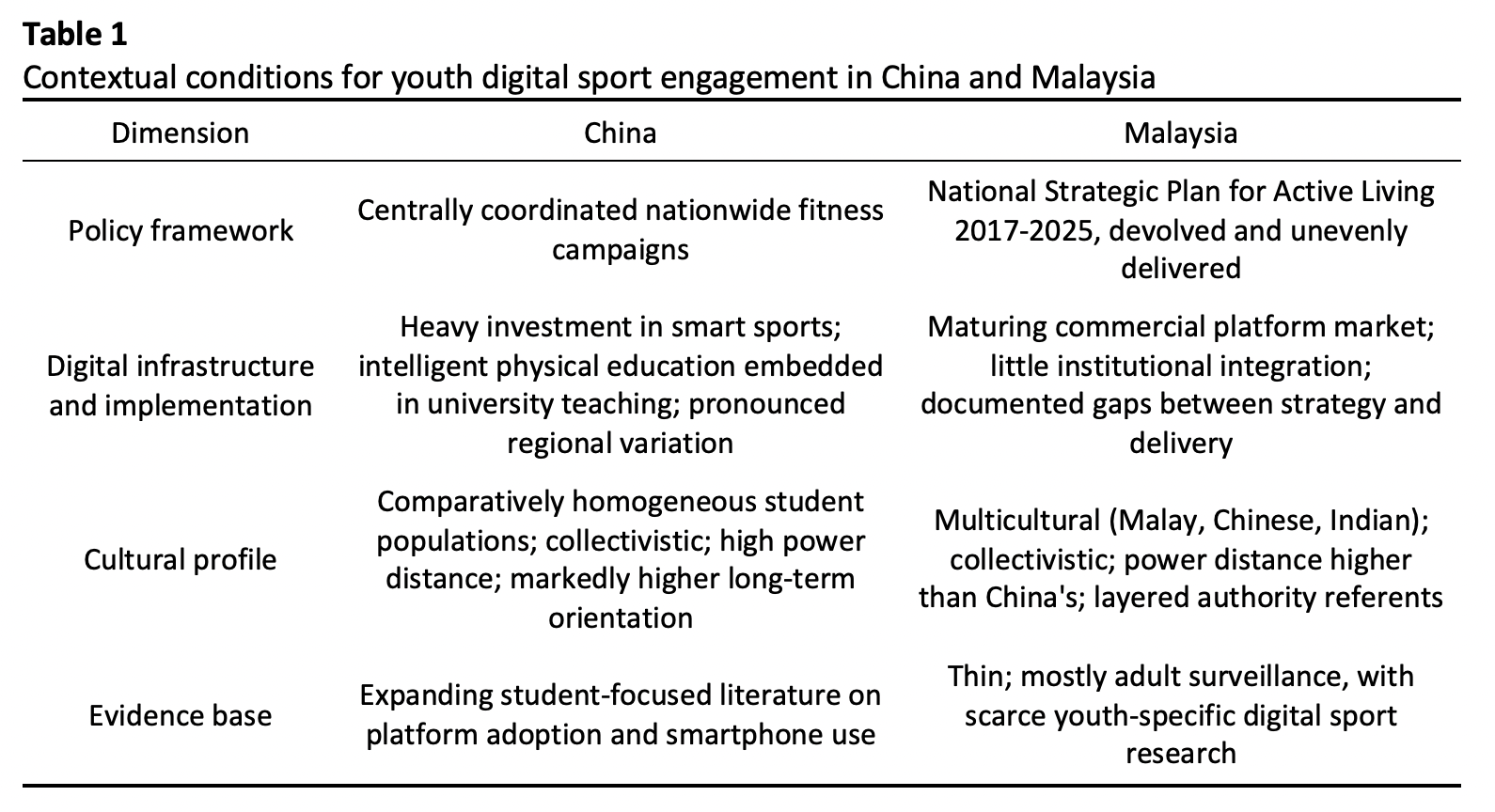
Digital platforms have become a principal route into exercise for young people, yet access alone has not translated into commensurate activity, and the cultural conditions under which engagement forms remain poorly understood. This review examines how culture shapes digital sport engagement among university-aged youth through a comparison of China and Malaysia, two societies sharing Eastern philosophical heritage and collectivistic traditions while diverging on power distance, long-term orientation, and internal cultural composition. Drawing together the technology acceptance and behavioural prediction traditions with Hofstede's dimensional framework, the review compares the institutional and cultural environments in which Chinese and Malaysian students encounter exercise technology and derives the mechanisms through which engagement plausibly diverges: authority endorsement operating through distinct institutional channels, normative influence transmitted through differently structured referent groups, usefulness judged against differently weighted goals, and the translation of intention into behaviour disciplined by social accountability to different degrees. These mechanisms condense into an integrated framework and six propositions specifying how technology perceptions, participation motivations, and individual-level cultural orientation, measured directly rather than inferred from nationality, combine to shape engagement intention and behaviour. The review clarifies the boundary conditions of digital sport engagement theory, offers platform developers grounds for culturally adaptive design, and provides the national fitness strategies of both countries a culturally calibrated evidence base.