Localising Whole-Institution Mental Health Education for Chinese Higher Vocational Colleges: A Critical Narrative Review and Integrative Design Synthesis
Keywords:
Higher vocational colleges, mental health education, localisation, whole-institution approach, vocational transition, ChinaAbstract
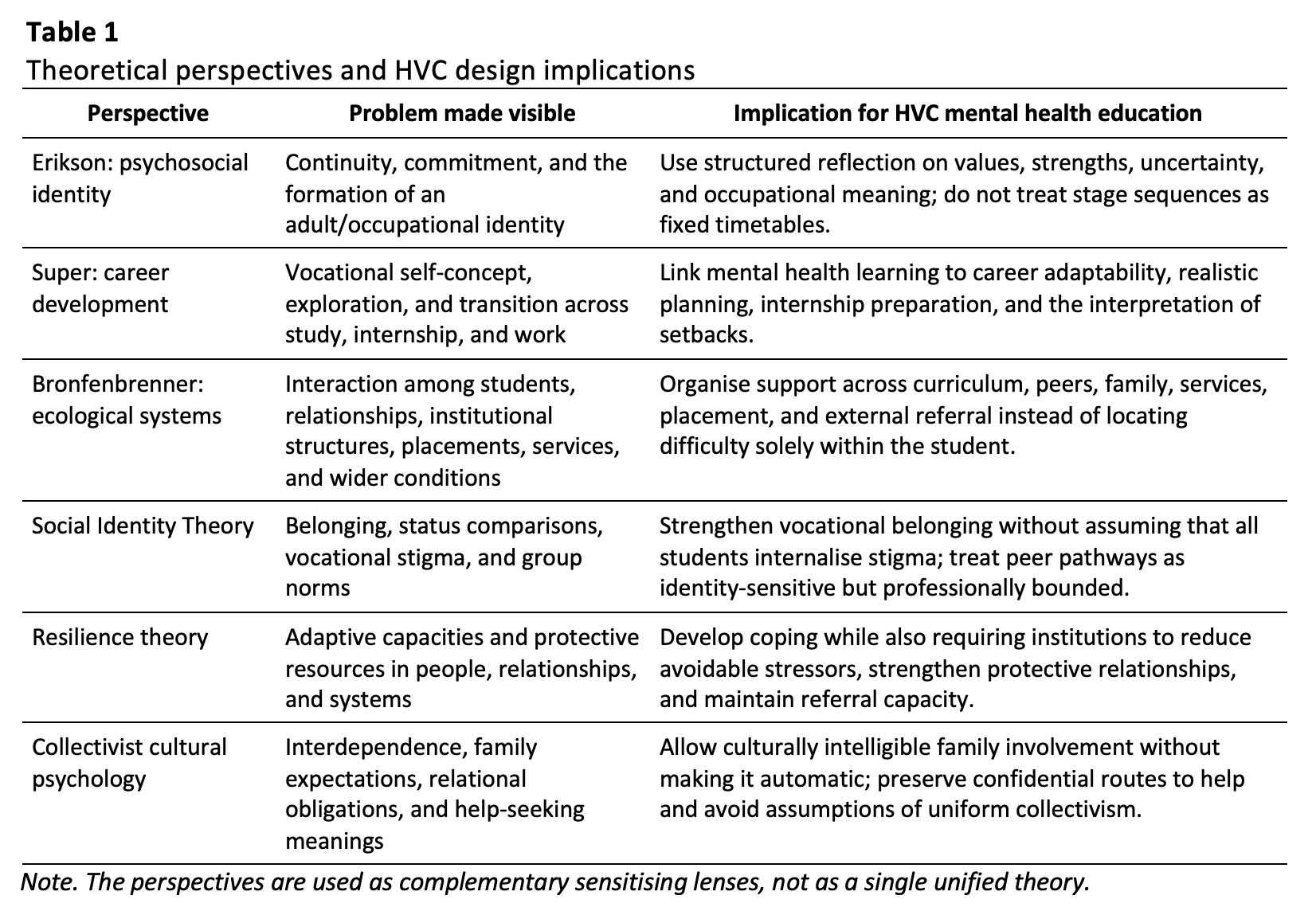
Whole-institution approaches have widened the university mental health agenda beyond counselling, but their most influential formulations were written for conventional university settings. That starting point matters for Chinese higher vocational colleges (HVCs), where practical training, internship, occupational identity, and an early school-to-work transition sit close to the centre of the curriculum. This critical narrative review asks what can reasonably be carried across from international whole-institution models and what has to be redesigned for the HVC context. It brings together work on mental health education and literacy, six theoretical perspectives, international frameworks, Chinese policy, and the still limited literature on vocational-college students. Reading these sources against the vocational student journey makes transition to work the point at which several otherwise separate concerns meet: identity, career development, institutional ecology, status and belonging, resilience, family expectations, and access to professional help. The review also exposes tensions that a local framework cannot solve by definition alone, particularly between student agency and relational obligations, coping and institutional responsibility, and broad educational participation and clinical role boundaries. From this analysis, four institutional functions recur: curriculum integration, delivery mechanisms, institutional support, and evaluation and feedback. Their value for HVCs lies less in the labels themselves than in the way they make internship continuity, vocational identity, external referral, confidentiality, and resource constraints explicit. The resulting architecture is offered as a design proposition for testing, not as evidence that any particular configuration is already effective.