Beyond Single-Channel Marketing: How Integrated Digital Marketing Strategies Drive Consumer Engagement through Trust
Keywords:
Integrated digital marketing, consumer engagement, consumer trust, stimulus-organism-response, platform e-commerceAbstract
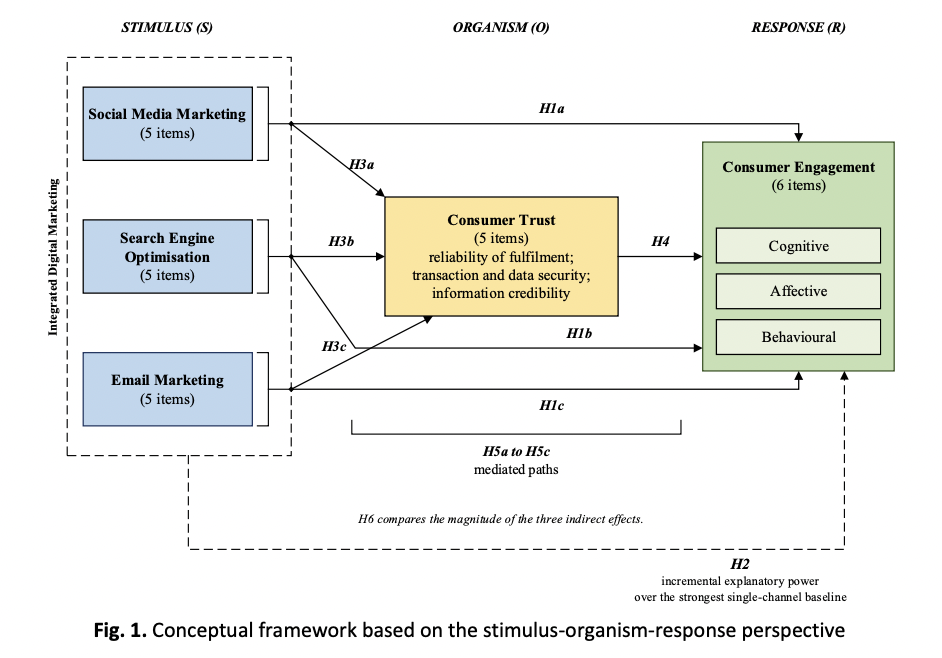
Platform users experience social media content, search results, and direct messages as parts of a unified purchasing experience when conducting transactions on platform-based e-commerce websites, but empirical research in the field of digital marketing tends to study each of these channels independently. This study examines whether an integrated specification of social media marketing, search engine optimisation, and email marketing explains a higher percentage of variation in consumer engagement than its independent baselines and whether consumer trust is mediating the effects of all three channels as opposed to one. Data have been collected in the form of a cross-sectional survey among 384 active consumers of Chinese e-commerce platforms using stratified random sampling and analysed with hierarchical regression and bootstrapping of the mediation model. Data quality measures have proven to be satisfactory, with internal consistency between 0.841 and 0.892 and average variance extracted between 0.547 and 0.581. An integrated model explained 48.0 per cent of the variance in consumer engagement, compared to 37.5 per cent explained by the strongest of single channels. This increment has been shown to be robust to model adjustments and cross-validation. Jointly estimated, the effect of social media marketing dropped by 38.4 per cent relative to its isolated estimate. Consumer trust partially mediated every path, transmitting between 27.9 and 30.7 per cent of each total effect, and pairwise contrasts between the indirect effects were not significant. Integration therefore yields measurable rather than rhetorical gains, and trust operates as a mechanism attached to the platform rather than to particular touchpoints.