Towards an Agile Governance Framework for Public Universities: Insights from Exploratory Factor Analysis
Keywords:
Agile governance, Exploratory Factor Analysis, good governance, governance framework, public universitiesAbstract
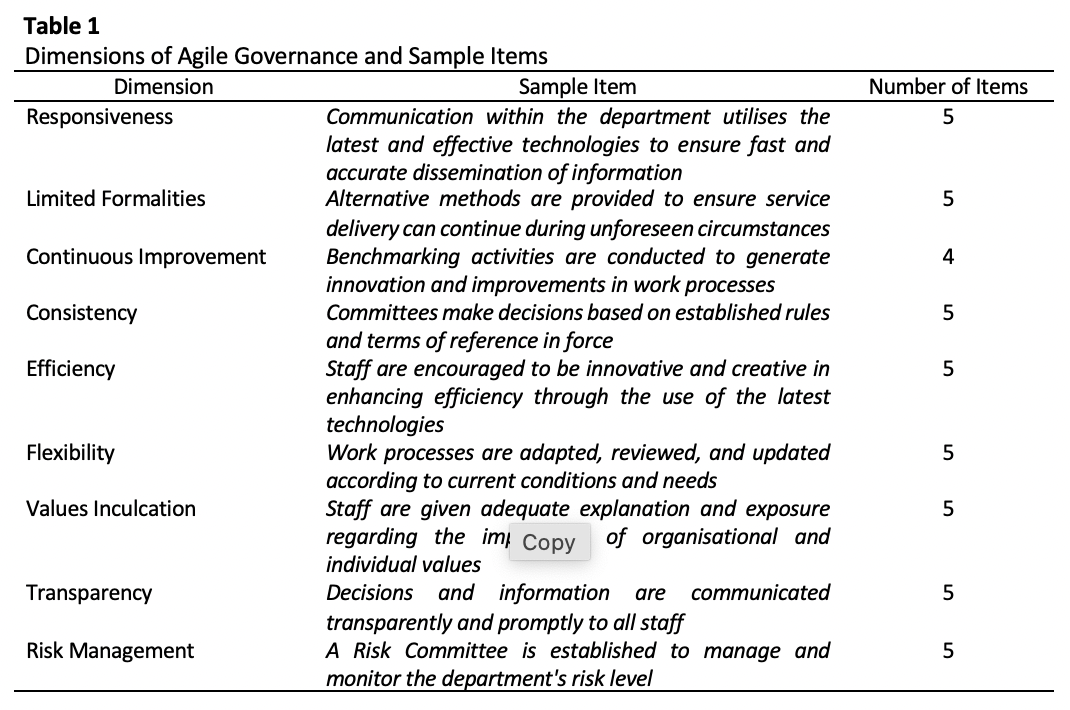
The evolving landscape of higher education demands governance models that are adaptive, transparent, and responsive to diverse stakeholder needs. Traditional governance structures in public universities often exhibit rigidity, fragmented decision-making, and limited adaptability to rapid technological, administrative, and pedagogical changes. Although agile governance has attracted considerable attention, its application within higher education remains relatively underexplored. This study proposes and empirically validates a multidimensional agile governance framework specifically tailored to public universities. Using a purposive sampling approach, data were collected from 150 staff members across faculties, campuses, and departments of a single Malaysian public university, and subsequently analysed using Exploratory Factor Analysis (EFA). The analysis identified nine core dimensions of agile governance: Responsiveness, Limited Formalities, Continuous Improvement, Consistency, Efficiency, Flexibility, Values Inculcation, Transparency, and Risk Management. Theoretically, this study extends the concept of agile governance by contextualising it within higher education and addressing the paucity of empirical instruments for assessing agility in university governance. Practically, the proposed framework provides university leaders with a structured, evidence-based guide for prioritising and embedding agility within institutional processes. By integrating ethical values, transparency, iterative learning, and proactive risk management, universities can cultivate governance practices that are both responsive and sustainable, while also anticipating potential implementation challenges.