
Social Support and Perceptions of Aging among Middle-Aged Adults: A Scoping Review

Authors

  • Ilmie Syafiqah Mohd Termizi Department of Human Development and Family Studies, Faculty of Human Ecology, Universiti Putra Malaysia, 43400 Serdang, Selangor, Malaysia
  • Asmidawati Ashari Department of Human Development and Family Studies, Faculty of Human Ecology, Universiti Putra Malaysia, 43400 Serdang, Selangor, Malaysia
  • Mohd Najmi Daud Department of Human Development and Family Studies, Faculty of Human Ecology, Universiti Putra Malaysia, 43400 Serdang, Selangor, Malaysia
  • Mohamad Salleh Abdul Ghani Department of Human Development and Family Studies, Faculty of Human Ecology, Universiti Putra Malaysia, 43400 Serdang, Selangor, Malaysia
  • Rojanah Kahar Department of Human Development and Family Studies, Faculty of Human Ecology, Universiti Putra Malaysia, 43400 Serdang, Selangor, Malaysia
  • Wan Arnidawati Wan Abdullah Department of Human Development and Family Studies, Faculty of Human Ecology, Universiti Putra Malaysia, 43400 Serdang, Selangor, Malaysia

Keywords:

Perceptions of aging, social support, middle-aged adults, scoping review, aging anxiety

Abstract

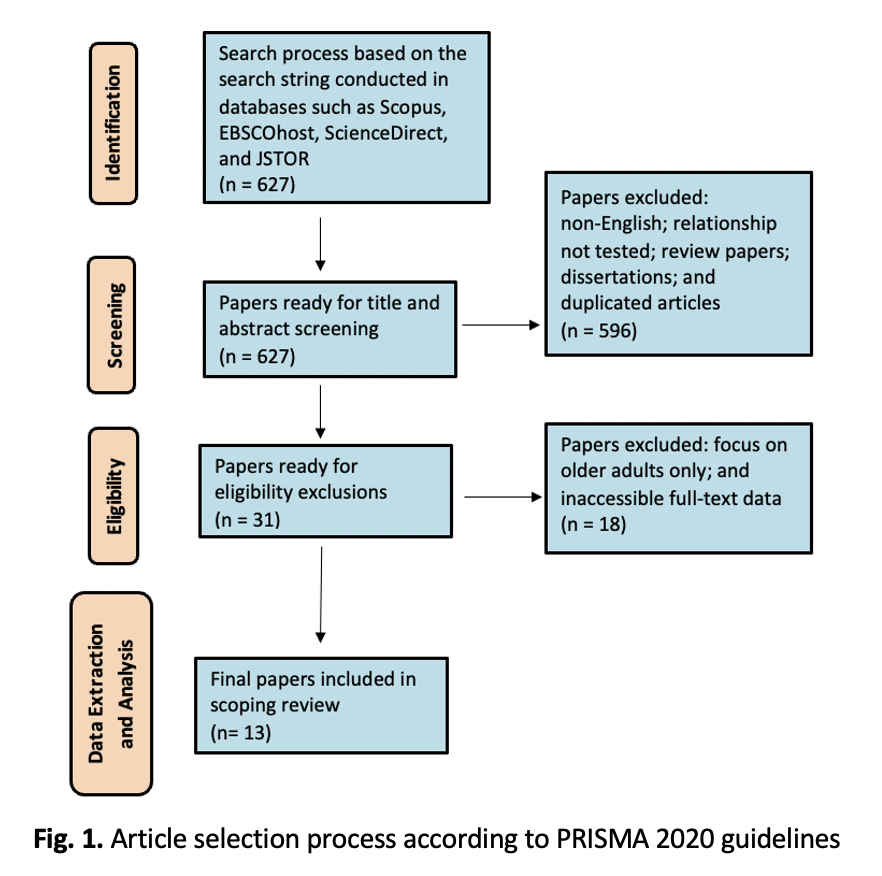
Perceptions of aging formed in midlife significantly influence long-term health and well-being, with social support being a key determinant of these perceptions. Existing studies syntheses focus predominantly on older adults (65+), creating a gap in our understanding of how social support shapes aging perceptions specifically during middle adulthood (ages 40-60). This scoping review aims to map the existing literature on the relationship between social support and perceptions of aging among middle-aged adults. Following PRISMA-ScR guidelines, we systematically searched Scopus, EBSCOhost, ScienceDirect, and JSTOR in July 2025. Of 627 records, 13 quantitative studies met the inclusion criteria. The reviewed studies were primarily cross-sectional (n=11) and geographically concentrated in East Asia (n=7). Three key themes emerged: (1) a bidirectional relationship between social support and aging perceptions; (2) social support as a buffer against aging anxiety, especially emotional and spousal support; and (3) the influence of life stage and social structure. The findings highlight the potential influence of cultural context, with preliminary evidence suggesting differences between family-centred support models in East Asia and more diverse networks in Western contexts. Midlife is a critical period for shaping aging trajectories through social support. However, the evidence base is limited by methodological homogeneity and geographic concentration. The review maps existing evidence and identifies priorities for future research and intervention development.

Author Biographies

Ilmie Syafiqah Mohd Termizi, Department of Human Development and Family Studies, Faculty of Human Ecology, Universiti Putra Malaysia, 43400 Serdang, Selangor, Malaysia

Asmidawati Ashari, Department of Human Development and Family Studies, Faculty of Human Ecology, Universiti Putra Malaysia, 43400 Serdang, Selangor, Malaysia

asmidawati@upm.edu.my

Mohd Najmi Daud, Department of Human Development and Family Studies, Faculty of Human Ecology, Universiti Putra Malaysia, 43400 Serdang, Selangor, Malaysia

Mohamad Salleh Abdul Ghani, Department of Human Development and Family Studies, Faculty of Human Ecology, Universiti Putra Malaysia, 43400 Serdang, Selangor, Malaysia

Rojanah Kahar, Department of Human Development and Family Studies, Faculty of Human Ecology, Universiti Putra Malaysia, 43400 Serdang, Selangor, Malaysia

Wan Arnidawati Wan Abdullah, Department of Human Development and Family Studies, Faculty of Human Ecology, Universiti Putra Malaysia, 43400 Serdang, Selangor, Malaysia

Downloads

Published

2026-01-07

Issue

Section

Articles