Mechanisms of Washback in Arabic Writing Assessment: Insights from Tertiary Learners

Authors

  • Ainul Rasyiqah Sazali Akademi Pengajian Bahasa, UiTM Shah Alam, Selangor Malaysia
  • Norhaslinda Hassan Akademi Pengajian Bahasa, UiTM Cawangan Pulau Pinang, Malaysia
  • Nurul ‘Atikah Rahman Pusat Bahasa, Universiti Islam Antarabangsa Malaysia (UIAM), Kuala Lumpur Malaysia
  • Tri Wahyu Retno Ningsih Faculty of Letters and Cultures, Gunadarma University, Indonesia

Keywords:

Washback, Arabic language, writing assessment, language acquisition

Abstract

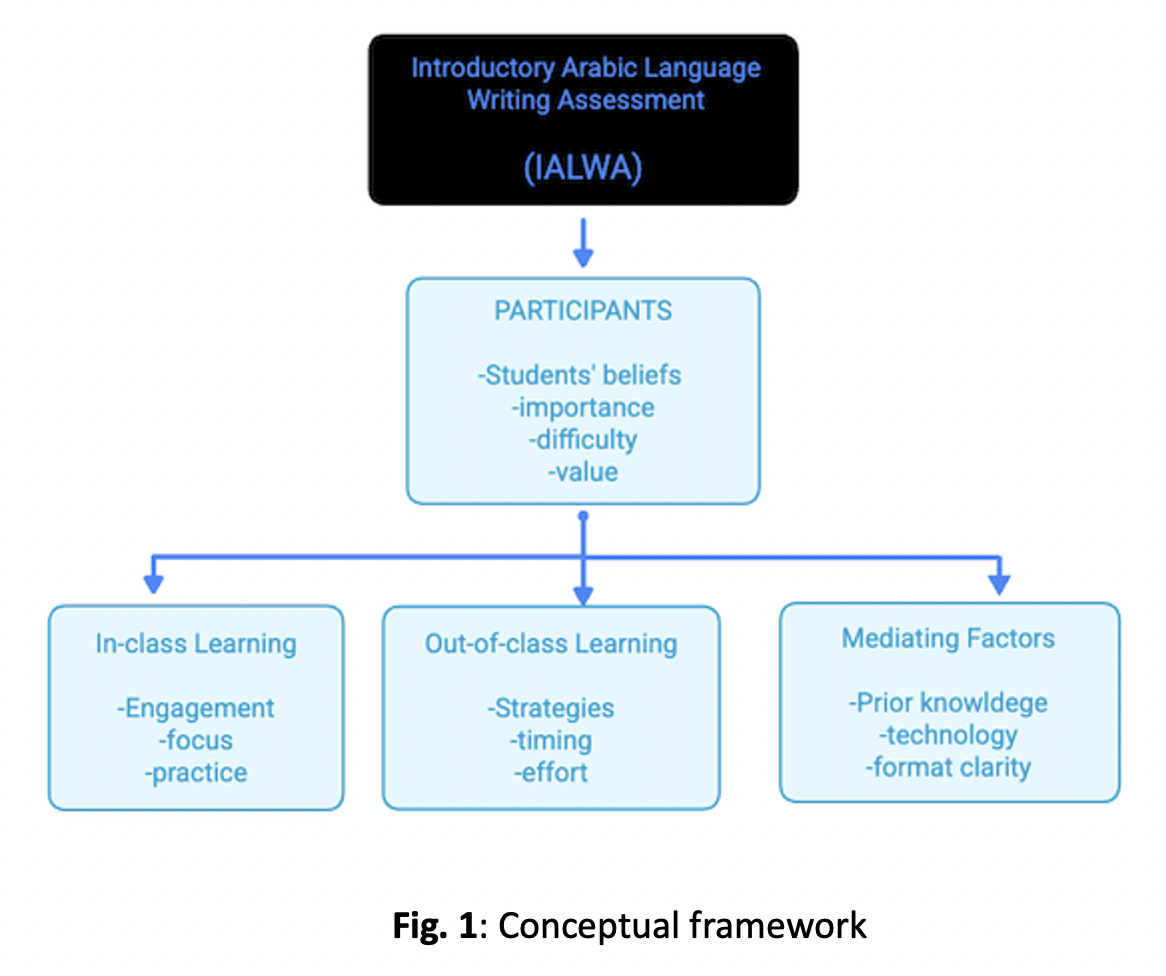
This study examines how the Introductory Arabic Language Writing Assessment (IALWA) shapes student learning within a Malaysian tertiary context, with particular attention to the mechanisms through which washback operates at the course level. Drawing on established washback frameworks, the study investigates learners’ perceptions of the assessment, its influence on in-class and out-of-class learning behaviours, and the instructional and technological factors that mediate these processes. A mixed-methods design was adopted to capture both behavioural patterns and learner interpretations. Qualitative data were generated through semi-structured interviews with six students to provide in-depth insights into learners’ experiences, while quantitative data from a survey of 40 learners were analysed using the Rasch Measurement Model to examine the relative strength and distribution of washback-related responses. The findings suggest that washback operates through interconnected pedagogical and contextual mechanisms rather than as a uniform effect. Pedagogically, alignment between instructional practices and assessment demands such as explicit guidance, structured revision, and the use of dummy tests was associated with focused engagement with vocabulary and grammar learning and with assessment-oriented preparation inside and outside the classroom. These patterns indicate locally constructive washback within the studied course. However, washback effects were moderated by non-pedagogical factors. Technical challenges related to the digital administration of the assessment, particularly Arabic keyboard use and internet stability, introduced additional cognitive demands for some learners. Students without prior exposure to Arabic also reported greater difficulty, which shaped their perceptions of the assessment and influenced how they approached preparation. Overall, the study highlights washback in Arabic writing assessment as a multidimensional and context-dependent process shaped by instructional clarity, assessment design, learner background, and technological conditions. While the findings are limited to a single course context, they offer analytic insights into how washback mechanisms function in introductory third-language writing assessment. The study underscores the importance of pedagogically aligned and technically accessible assessment practices and provides directions for future research examining washback across broader learner populations, skills, and institutional settings.

Author Biographies

Ainul Rasyiqah Sazali, Akademi Pengajian Bahasa, UiTM Shah Alam, Selangor Malaysia

ainul437@uitm.edu.my

Norhaslinda Hassan, Akademi Pengajian Bahasa, UiTM Cawangan Pulau Pinang, Malaysia

haslinda.hassan@uitm.edu.my

Nurul ‘Atikah Rahman, Pusat Bahasa, Universiti Islam Antarabangsa Malaysia (UIAM), Kuala Lumpur Malaysia

atikahrahman@iium.edu.my

Tri Wahyu Retno Ningsih, Faculty of Letters and Cultures, Gunadarma University, Indonesia

twahyurn@gmail.com

Downloads

Published

2026-01-07

Issue

Section

Articles