A Longitudinal Reflection on the Mentoring Experience of a Teacher of Disabled Children
Keywords:
Longitudinal mentoring, reflective practice, special educational needs teachers, professional learning and development, reflective mentoringAbstract
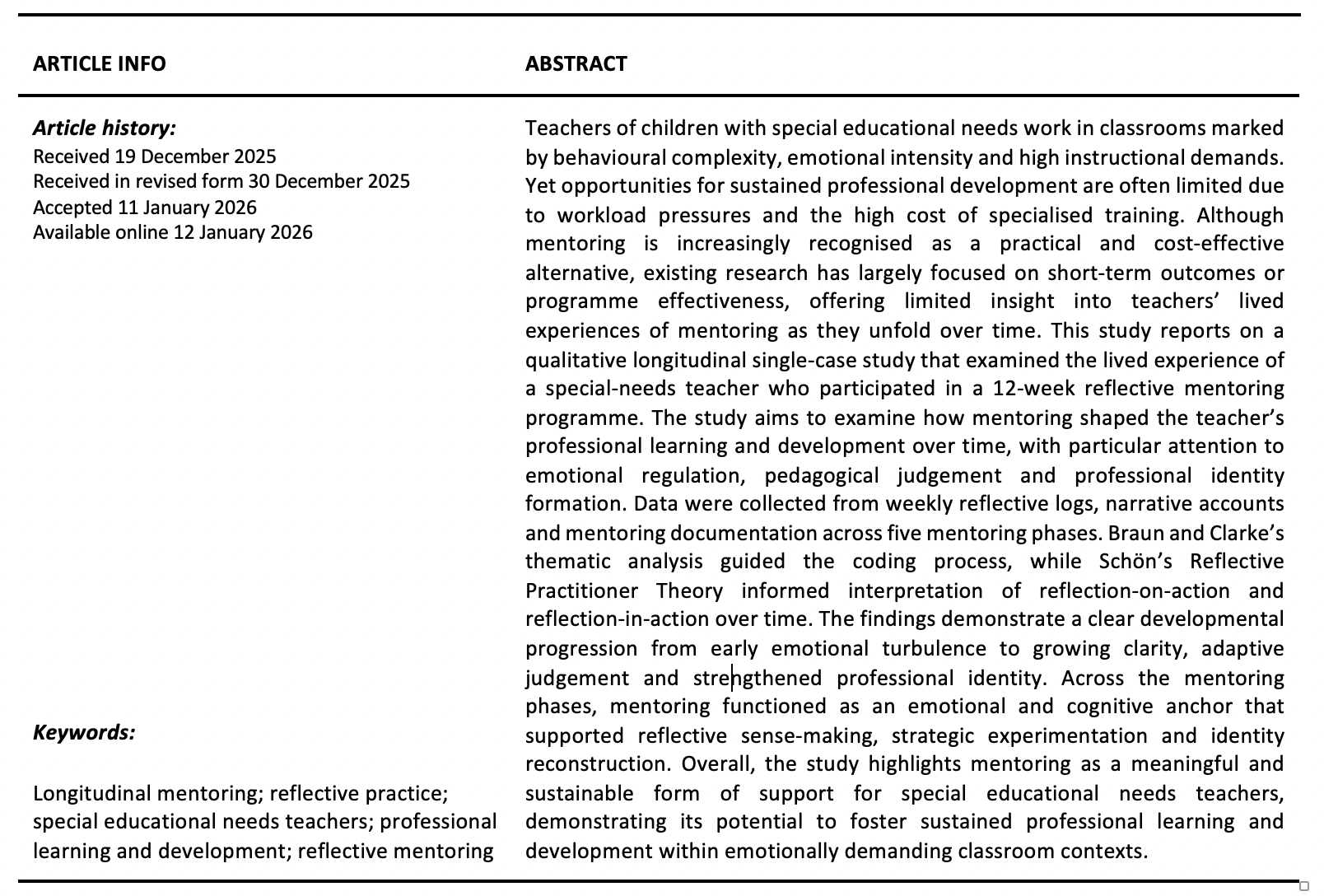
Teachers of children with special educational needs work in classrooms marked by behavioural complexity, emotional intensity and high instructional demands. Yet opportunities for sustained professional development are often limited due to workload pressures and the high cost of specialised training. Although mentoring is increasingly recognised as a practical and cost-effective alternative, existing research has largely focused on short-term outcomes or programme effectiveness, offering limited insight into teachers’ lived experiences of mentoring as they unfold over time. This study reports on a qualitative longitudinal single-case study that examined the lived experience of a special-needs teacher who participated in a 12-week reflective mentoring programme. The study aims to examine how mentoring shaped the teacher’s professional learning and development over time, with particular attention to emotional regulation, pedagogical judgement and professional identity formation. Data were collected from weekly reflective logs, narrative accounts and mentoring documentation across five mentoring phases. Braun and Clarke’s thematic analysis guided the coding process, while Schön’s Reflective Practitioner Theory informed interpretation of reflection-on-action and reflection-in-action over time. The findings demonstrate a clear developmental progression from early emotional turbulence to growing clarity, adaptive judgement and strengthened professional identity. Across the mentoring phases, mentoring functioned as an emotional and cognitive anchor that supported reflective sense-making, strategic experimentation and identity reconstruction. Overall, the study highlights mentoring as a meaningful and sustainable form of support for special educational needs teachers, demonstrating its potential to foster sustained professional learning and development within emotionally demanding classroom contexts.