Review on the Development Context and Current Situation of Chinese Children's Piano Learning -- Based on Literature Analysis

Authors

  • Li Qiushuo Faculty of Education and Liberal Studies, City University of Malaysia,Kuala Lumpur, 50470, Malaysia
  • Lily Muliana Mustafa Faculty of Education and Liberal Studies, City University of Malaysia,Kuala Lumpur, 50470, Malaysia

DOI:

https://doi.org/10.37934/arsbs.42.1.265282

Keywords:

Children’s piano learning, status review, systematic literature review

Abstract

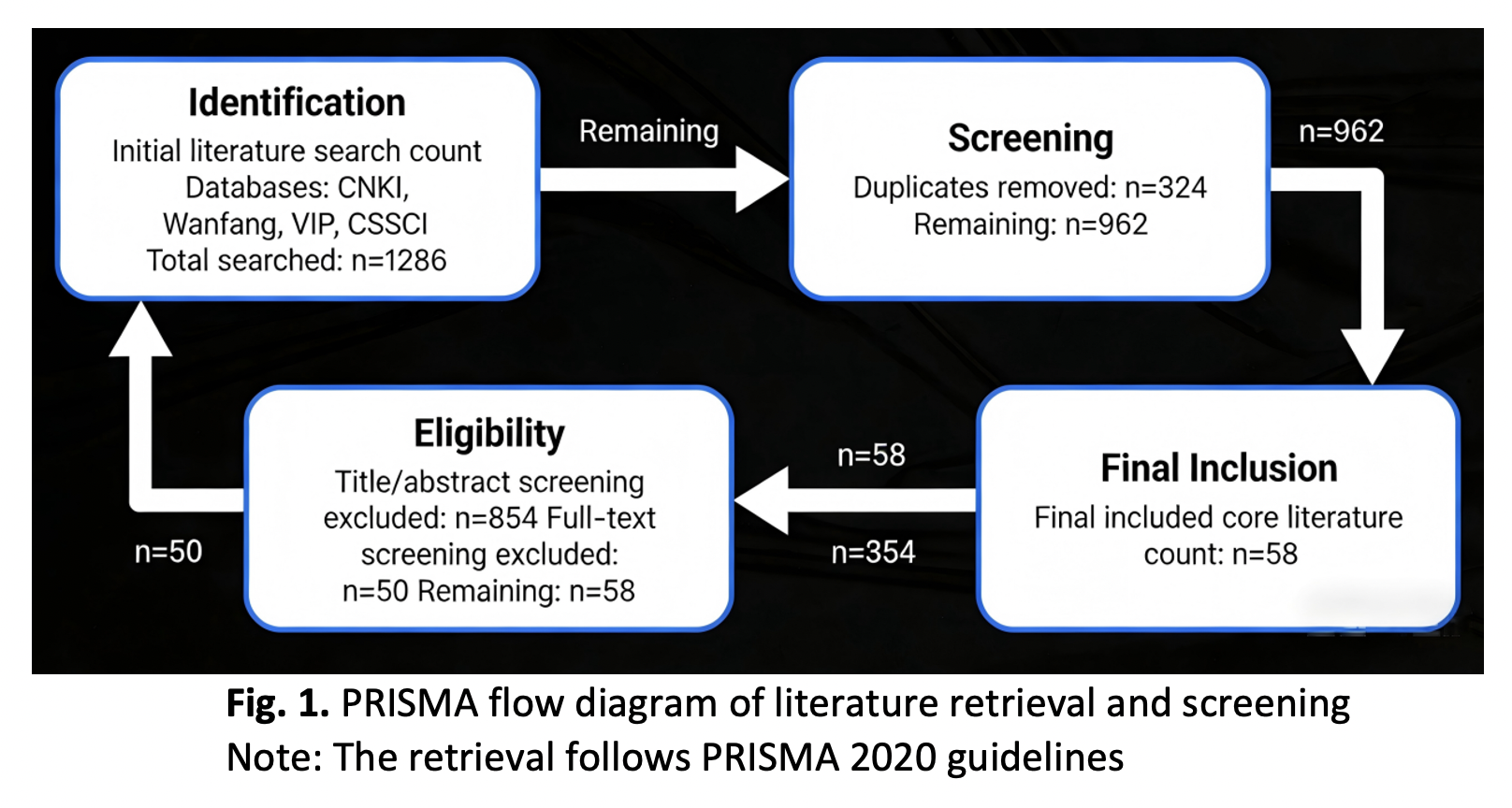
This study adopts a Systematic Literature Review (SLR) approach, strictly following the PRISMA 2020 guidelines, to systematically analyze 58 core literatures retrieved from CNKI, CSSCI, Wanfang and other databases, covering the period from the 1950s to June 2024.   The research aims to sort out the evolutionary context of Chinese children’s piano learning, analyze its current development status, and respond to core academic controversies.   The results show that Chinese children’s piano learning has experienced three distinct stages—germination period (1950s–1980s) characterized by elite professional orientation, exploration period (1990s–2000s) driven by popularization and grade examination, and development period (2010s–2024) featuring diversified goals and intensive policies—with the synergistic driving effect of policy,   economic and family factors promoting its transformation from elite training to universal aesthetic education.   From the four dimensions of policy implementation, family participation, resource distribution and teaching practice, the current development presents structural contradictions such as the "implementation temperature difference" of policies, the imbalance of family participation dimensions, the prominent urban-rural resource gap, and the localization dilemma of teaching methods.   The core academic controversies including the conflict between grade examination orientation and aesthetic education orientation, and the selection of resource balance paths can be resolved through age-differentiated integration strategies and government-market synergy paths.   This study fills the academic gap of systematic integration of development context and in-depth analysis of localized status in the field, and provides empirical support and practical reference for the high-quality and equitable development of Chinese children’s piano education.

Author Biography

Lily Muliana Mustafa, Faculty of Education and Liberal Studies, City University of Malaysia,Kuala Lumpur, 50470, Malaysia

lily.muliana@city.edu.my

Downloads

Published

2026-03-25

Issue

Section

Articles