From Online Research to In-Store Purchase: Explaining Malaysian Gen Z Webrooming for High-Involvement Appliances
Keywords:
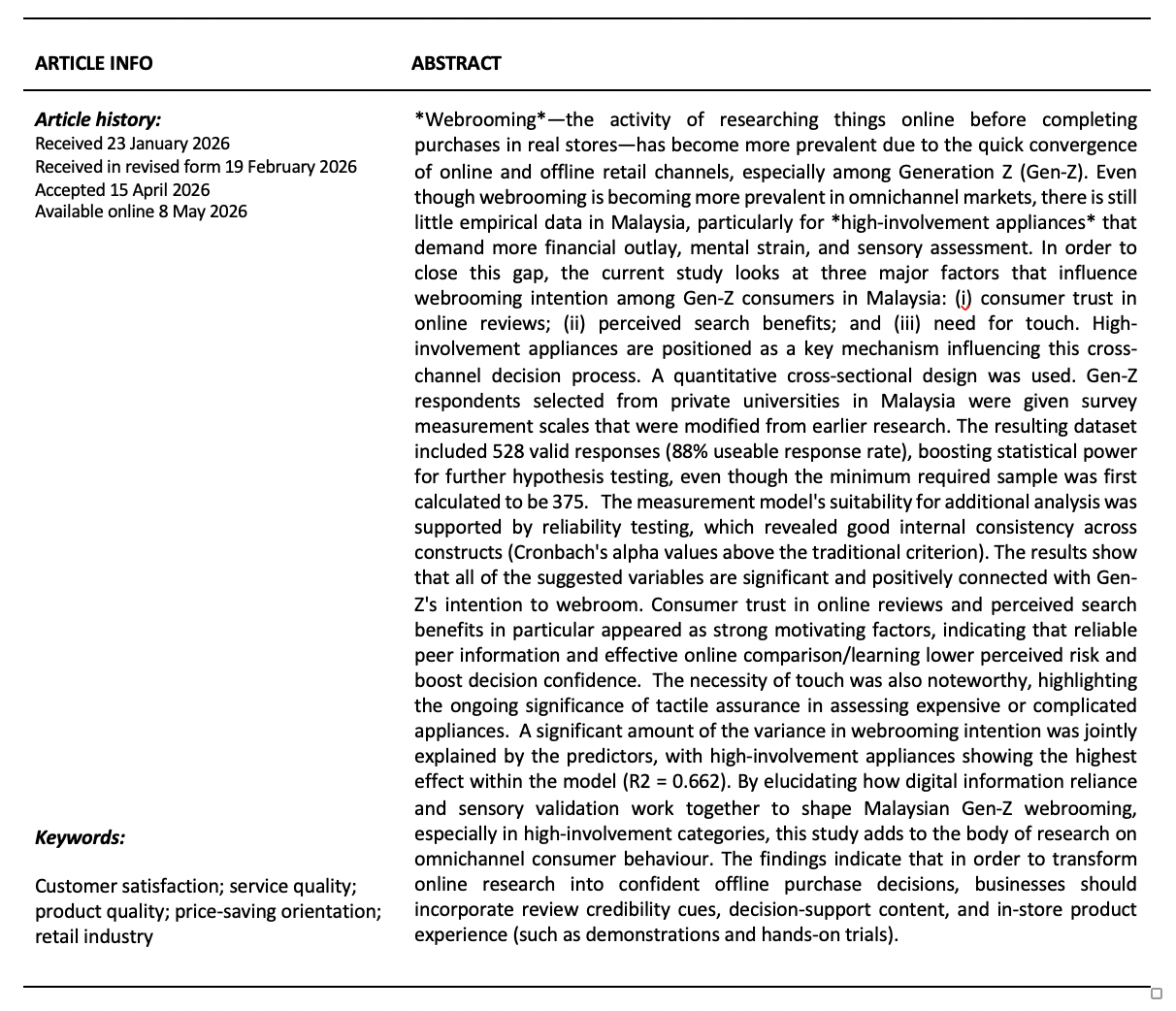
Customer satisfaction, service quality, product quality, price-saving orientation, retail industryAbstract
*Webrooming*—the activity of researching things online before completing purchases in real stores—has become more prevalent due to the quick convergence of online and offline retail channels, especially among Generation Z (Gen-Z). Even though webrooming is becoming more prevalent in omnichannel markets, there is still little empirical data in Malaysia, particularly for *high-involvement appliances* that demand more financial outlay, mental strain, and sensory assessment. In order to close this gap, the current study looks at three major factors that influence webrooming intention among Gen-Z consumers in Malaysia: (i) consumer trust in online reviews; (ii) perceived search benefits; and (iii) need for touch. High-involvement appliances are positioned as a key mechanism influencing this cross-channel decision process. A quantitative cross-sectional design was used. Gen-Z respondents selected from private universities in Malaysia were given survey measurement scales that were modified from earlier research. The resulting dataset included 528 valid responses (88% useable response rate), boosting statistical power for further hypothesis testing, even though the minimum required sample was first calculated to be 375. The measurement model's suitability for additional analysis was supported by reliability testing, which revealed good internal consistency across constructs (Cronbach's alpha values above the traditional criterion). The results show that all of the suggested variables are significant and positively connected with Gen-Z's intention to webroom. Consumer trust in online reviews and perceived search benefits in particular appeared as strong motivating factors, indicating that reliable peer information and effective online comparison/learning lower perceived risk and boost decision confidence. The necessity of touch was also noteworthy, highlighting the ongoing significance of tactile assurance in assessing expensive or complicated appliances. A significant amount of the variance in webrooming intention was jointly explained by the predictors, with high-involvement appliances showing the highest effect within the model (R2 = 0.662). By elucidating how digital information reliance and sensory validation work together to shape Malaysian Gen-Z webrooming, especially in high-involvement categories, this study adds to the body of research on omnichannel consumer behaviour. The findings indicate that in order to transform online research into confident offline purchase decisions, businesses should incorporate review credibility cues, decision-support content, and in-store product experience (such as demonstrations and hands-on trials).