Analysis of Flow Characteristics in a Cross Flow Heat Exchanger
DOI:
https://doi.org/10.37934/afhme.9.1.2834aKeywords:
CFD, cross flow, heat exchanger, grid independence, turbulence modellingAbstract
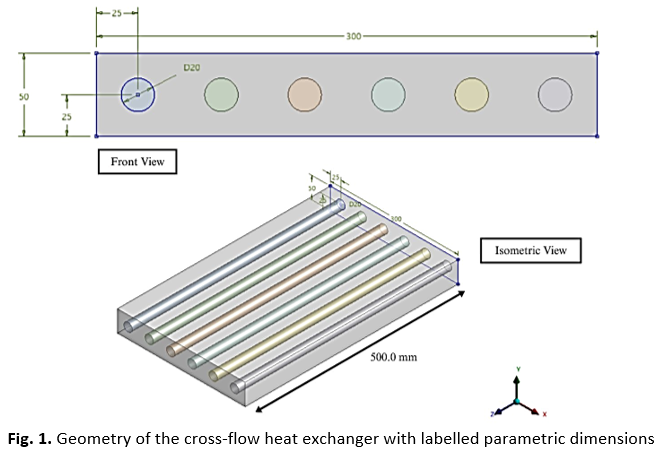
Heat exchangers are critical components within advanced thermal management systems utilized across various engineering industries. Cross flow configurations are prevalent due to their compact design and efficient heat transfer capabilities. However, analysing the performance of these devices presents a significant challenge. This difficulty arises from complex fluid interactions, intricate thermal mixing processes, and adverse pressure gradients that lead to boundary layer detachment and flow separation behind cylindrical structures. The specific problem addressed in this study is the accurate numerical prediction of the thermal mixing behaviour and turbulent wakes generated by sequentially heated pipes within a rectangular duct. Consequently, the primary aim of this research is to evaluate the influence of different turbulence models on the predicted thermal performance, focusing on the mass weighted average outlet temperature. The methodology employs ANSYS Fluent software to conduct steady state simulations of air flowing at a low inlet velocity of 0.001 meters per second. The computational domain features a three-dimensional rectangular duct housing six internal pipes heated sequentially with constant wall temperatures ranging from 400 K to 450 K. The fluid domain was discretized using an unstructured meshing strategy with strict inflation layers to capture severe near wall thermal gradients. A Grid Independence Test was performed across four varying mesh resolutions to eliminate numerical discretization errors. Following mesh validation, three distinct turbulence models, specifically the Standard k-epsilon, Realizable k-epsilon, and k-omega Shear Stress Transport models, were employed to simulate the convective heat transfer. The quantitative results from the Grid Independence Test established that a 2.0 mm element size mesh comprising 273205 nodes successfully achieved grid independence with a negligible percentage difference of 0.002%. The subsequent comparison revealed that the baseline k-omega model predicted a mass weighted average outlet temperature of 401.54 K. In contrast, both k-epsilon models over predicted the thermal mixing rates, yielding identical outlet temperatures of 401.79 K. In conclusion, the comparative analysis demonstrates that the k-omega model is the most physically accurate choice for predicting thermal performance in cross flow heat exchanger configurations. Its superior formulation for resolving viscous sublayers and handling adverse pressure gradients actively prevents the artificial over prediction of convective mixing.