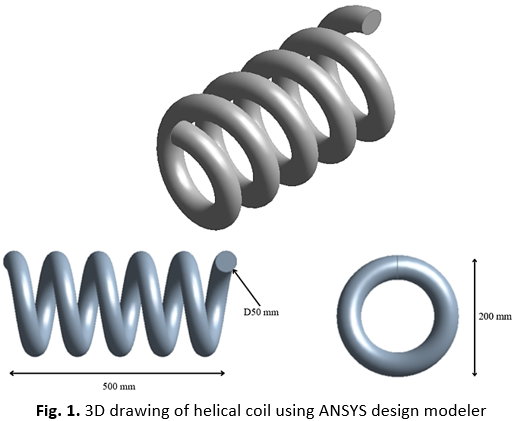
Modelling of Flow Behaviour in the Curvature of Helical Coil
DOI:
https://doi.org/10.37934/afhme.9.1.1927aKeywords:
Helical coil, CFD simulation, grid independence test, pressure drop, flow regimesAbstract
Helical coils are widely utilized in industrial heat exchangers and chemical reactors due to their compact design and superior mixing capabilities compared to straight pipes. However, the complex secondary flow patterns induced by centrifugal forces create significant challenges in predicting hydraulic performance and energy requirements across different flow regimes. This research addresses the problem of accurately characterizing the transition from viscous-dominated laminar flow to inertia-dominated turbulence within curved geometries. The purpose of this study is to evaluate the influence of varying Reynolds numbers on flow topology, velocity and pressure drop characteristics. The investigation was conducted using a three-dimensional numerical simulation approach in ANSYS Fluent 2026 R1. A strong methodology was employed, featuring an unstructured patch conforming tetrahedral mesh evaluated across three distinct element resolutions to establish a Grid Independence Test (GIT). High velocity gradients adjacent to the tube walls were resolved using structured inflation layer boundaries. Steady-state simulations were executed at a fixed inlet mass flow rate of 0.01kg/s, utilizing a laminar viscous solver for low velocities, a three-equation Transition k-kl-omega model for transitional regions and a four-equation Shear Stress Transport (SST) k-omega model for fully developed turbulent environments. Quantitative results from the mesh validation show that the medium mesh resolution with 5mm element size successfully achieved numerical independence, which preserving a stable solution with a negligible pressure drop error margin of less than 3% compared to the fine mesh at 4mm while optimizing computational time. Hydrodynamic extractions reveal that under laminar conditions (Re < 2300), the viscous forces effectively suppress fluid fluctuations, which resulting in a maximum velocity magnitude of 7.806×10^(-3)m/s at the central core. Conversely, operating under transition (Re=4000) and turbulent (Re > 10,000) conditions triggers strong centrifugal fields that force the high-velocity core outward, successfully establishing counter-rotating Dean vortices. While the laminar regime maintains a steady, linear pressure distribution along the 500mm coil length, the onset of turbulent secondary flow patterns causes an aggressive, non-linear pressure drop concentrated near the inlet boundary. The study concludes that while the highly energetic turbulent regime offers optimal structural fluid mixing, the laminar regime remains the most energy-efficient configuration for primary fluid transport, providing a precise technical baseline for the geometric design and pumping optimization of helical piping networks.