Computational Modelling of Flow Characteristic in a Venturi Flow
DOI:
https://doi.org/10.37934/afhme.9.1.1018aKeywords:
Bernoulli, ANSYS Fluent, grit independence test, pressure drop, velocity distributionAbstract
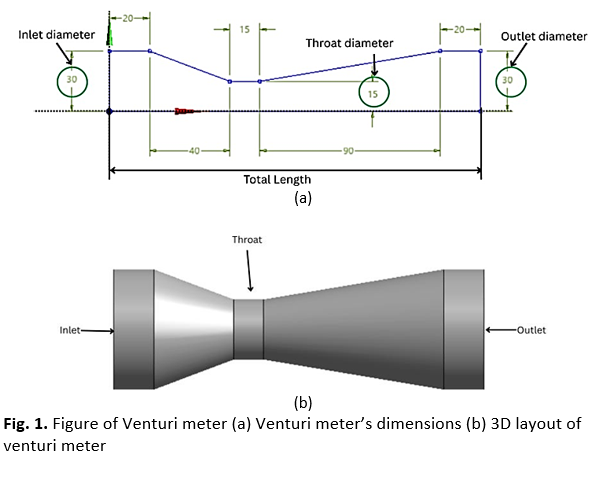
The Venturi flow meter is widely used in fluid engineering applications to measure the flowrate of liquids and gases due to its simple design and low pressure loss. However, the accuracy of pressure prediction in Computational Fluid Dynamics (CFD) simulations can be influenced by the turbulence model selected which may lead to variations of the simulation results. Therefore, this study investigates the pressure characteristics of a Venturi flow meter and compares the performance of three turbulence models using Ansys Fluent. A three dimensional Venturi flow meter with inlet and outlet diameters of 30mm, a throat with diameter of 15mm and a total length of 185mm was developed and analysed under steady state conditions. Water was used as the working fluid with an inlet velocity of 2.2 m/s. To ensure reliable numerical results, a Grid Independence Test (GIT) was conducted and a mesh with an element size of 3.5mm consisting of 17962 nodes and 13584 elements was selected for the final simulation. Three turbulence models were evaluated which realizable k–ε models, the standard k–ε and standard k–ω. The results showed a pressure drop of approximately 8397.8 Pa between the inlet and throat sections followed by pressure recovery towards the outlet which agrees with the operating principle of the venturi flow meter. All three turbulence models was able to predict the general pressure and velocity behaviour within the flow domain. However, differences were observed in their convergence performance and flow predictions. Among these model tested, the most stable convergence behaviour is the realizable k–ε models and produced smoother pressure contours and velocity streamlines compared to the others model. Based on the findings, the realizable k–ε models was identified as the most suitable turbulence model for predicting the pressure characteristics of the venturi flow meter.