Analysis of the Jet Impingement Cooling on a Heated Flat Plate
DOI:
https://doi.org/10.37934/afhme.9.1.19aKeywords:
Jet impingement cooling, Computational Fluid Dynamics (CFD), grid independence test, mesh resolution, velocity distribution, stagnation regionAbstract
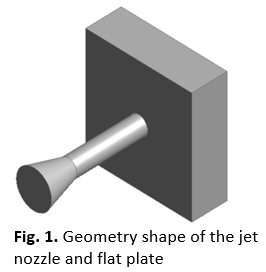
Jet impingement cooling is frequently used in thermal engineering because it can reach high heat transfer rates. Previous study has reported that mesh quality and resolution have a significant impact on the accuracy of Computational Fluid Dynamics (CFD) simulations especially in regions with large gradients such as the stagnation zone. In this case, improper mesh selection may cause the incorrect prediction of flow behaviour. So, the purpose of this study is to investigate the effect of mesh resolution on the numerical modelling of jet impingement cooling on a heated flat plate. The simulation was conducted in ANSYS Fluent using three-dimensional model consisting of a vertical nozzle and a flat plate. The model then is meshed into three different sizes namely, coarse, medium and fine mesh. The simulation is then run under steady-state conditions with the k-ε turbulence model. The results were analysed for velocity distribution, pressure contours, streamline patterns, and velocity profiles along the jet centerline. From the result, Grid Independence Test shows that maximum velocity increase from 7.355m/s for coarse mesh to 7.439 m/s for medium mesh. Only small difference is observed between medium and fine mesh. Medium mesh contains 114,802 elements is selected as optimal mesh due to the balance between accuracy and computational efficiency. The flow behaviour shows the formation of a stagnation region at the point of impingement then followed by radial spreading of the flow throughout the surface. In conclusion, the medium mesh is sufficient for effectively capturing flow properties while keeping computational efficiency. This study confirms the importance of mesh selection in CFD simulations beside showing the effects on the accuracy of jet impingement cooling analysis.