Stress and Deformation Analysis of Steel Sleeve Repair Welding Pipe
DOI:
https://doi.org/10.37934/afhme.10.1.1927aAbstract
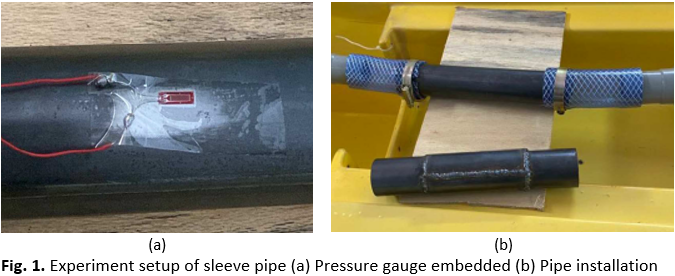
Sleeve repair welding (SRW) is a medium-sized pipeline repair task to minimize pipeline shutdowns. However, weldment quality and pipe burn-through were noted as concerns. Excessive residual loads and deformations were the primary cause of poor weld quality. This study aimed to find the ideal steel sleeve size and internal pipeline flow conditions for minimizing residual stresses and deformation. The test is carried out with a strain gauge as a measuring tool. The strain gauge used is a single-axis strain gauge, type FLA-5-11. To complete the objective of this study which is to identify the effect of steel sleeve welding on steel pipe, there are some results gathered. The analysis is based on the strain, stress, and deformation readings obtained from the strain gauge. The steel pipes were tested with different pressures, 2 psi, 4 psi, 8 psi, and 12 psi. Besides that, the strain gauge was also positioned with different orientations which are horizontal and vertical orientations to observe and compare the result with different orientations. All the results are taken from different positions on steel pipe which are at the top and bottom of the steel pipe, with sleeve repair and without SRW. The result demonstrates that steel pipe with SRW has less strain, stress, and deformation compared to steel pipe without SRW. Hence this shows that the steel repair method can help in reducing the bad effects of defects that happens in underground pipeline systems. It also shows that the effect of pressure in steel pipe happens to be more at the bottom of the steel pipe compared to at the top of steel pipe. These indicates that the steel SRW and reinforcement of steel pipe at the bottom of is important.