Simulation of Flow Pattern Around a Triangular Prism with Different Base Angles
DOI:
https://doi.org/10.37934/afhme.8.1.3950aKeywords:
Triangular prism, computational fluid dynamics, bluff body aerodynamics, wake topology, flow separationAbstract
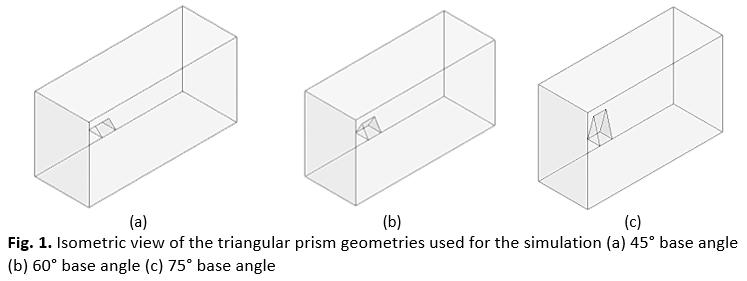
The study of external fluid dynamics over bluff bodies is a cornerstone of aerodynamic and civil engineering, fundamental to designing structures that can withstand significant wind loads. Unlike streamlined shapes, bluff bodies like triangular prisms induce strong flow separation, creating complex wake regions that directly influence structural stability. However, the specific impact of the prism’s base angle on the intensity of this separation and the resulting drag forces remains a critical parameter that requires detailed quantification. The primary purpose of this research is to investigate the external flow dynamics around triangular prisms with distinct base angles of 45°, 60°, and 75° to determine how geometric sharpness affects aerodynamic performance. The study utilized Computational Fluid Dynamics (CFD) using the ANSYS Fluent solver. The Reynolds-Averaged Navier-Stokes (RANS) equations were solved using the Shear Stress Transport (SST) k-omega turbulence model, which is specifically suited for predicting flow separation under adverse pressure gradients. A Grid Independence Test was first performed to establish an optimal mesh resolution of 8 mm, ensuring numerical accuracy. The principal results demonstrated a significant correlation between the base angle and wake topology. The 45° prism exhibited a confined separation bubble and rapid flow recovery. In contrast, the 75° prism generated a massive recirculation zone with a severe velocity deficit, where the wake velocity dropped to 13 m/s, accompanied by the largest pressure differential between the front and rear faces. It is concluded that increasing the base angle significantly amplifies form drag by widening the wake and delaying pressure recovery. Consequently, shallower base angles are recommended for engineering applications requiring minimized aerodynamic resistance.