CFD Study of Wind Flow Interaction between Single and Double Building Blocks
DOI:
https://doi.org/10.37934/afhme.8.1.3136aKeywords:
Computational fluid dynamics, wind flow around, building interaction, single and double building blocks, urban wind environment, flow pattern, velocity fieldAbstract
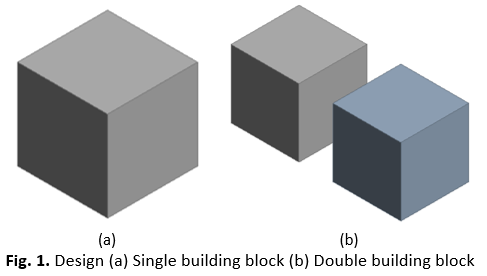
Wind flow around buildings is a critical factor in urban planning and wind engineering, as it directly affects pedestrian comfort and structural safety. When wind interacts with structures, it creates complex phenomena such as flow separation, recirculation zones, and wake formation. This study investigates the external flow behaviour around single and double building blocks using Computational Fluid Dynamics (CFD). Three-dimensional cubic models with dimensions of 20 mm × 20 mm × 20 mm were created and simulated using ANSYS Fluent. Air was selected as the working fluid, and three inlet velocities of 2 m/s, 5 m/s, and 8 m/s were applied to represent typical Malaysian wind conditions. Turbulent flow conditions were modelled using the standard k-epsilon turbulence model. A grid independence test was conducted to ensure that the results were independent of mesh resolution, leading to the selection of an 80,000 nodes mesh. Velocity and pressure contours were analysed to compare flow distribution and wake development between the two configurations. The results show that building arrangement significantly influences flow behaviour. The single-block case produced a predictable wake region, while the double-block configuration exhibited a distinct "channelling effect," where the wind accelerated significantly in the gap between the buildings. Higher inlet velocities intensified these patterns, leading to larger recirculation zones and merged wakes. In conclusion, the presence of neighbouring buildings and higher wind speeds creates more complex aerodynamic interactions that must be considered in urban design. These findings can help improve building layouts for better wind environmental quality in urban areas.