CFD Analysis of Aerodynamic Drag Over a Simplified Car Body with and without Spoiler
CFD
DOI:
https://doi.org/10.37934/afhme.8.1.2430aKeywords:
Aerodynamic drag, CFD, car body, spoiler, wake flow, drag coefficientAbstract
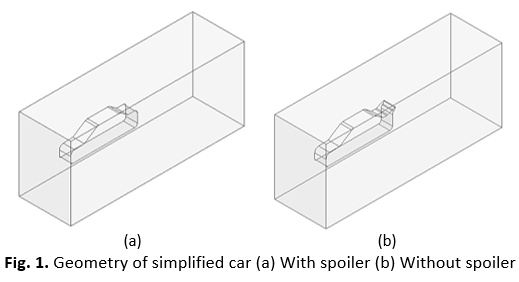
Aerodynamic drag plays a critical role in determining vehicle performance, fuel efficiency, and stability, particularly at high speeds. In this study, Computational Fluid Dynamics (CFD) is employed to analyse the aerodynamic characteristics of a simplified passenger car body with and without a rear spoiler. The simulations are conducted at three free-stream velocities: 30 m/s, 60 m/s, and 90 m/s, representing low, medium, and high-speed driving conditions. The primary objectives are to evaluate drag force, drag coefficient, pressure distribution, velocity contours, and wake structure for both configurations. All simulations are performed under steady, incompressible flow conditions using the finite volume method. A grid independence test is conducted to ensure numerical reliability, and identical solver settings are applied to all cases for fair comparison. The results demonstrate that the presence of a rear spoiler significantly alters the wake structure, reduces flow separation, and lowers aerodynamic drag at higher velocities. At 90 m/s, the car model with spoiler shows the greatest drag reduction compared to the baseline configuration. The findings confirm that aerodynamic appendages such as spoilers become increasingly effective as vehicle speed increases and provide valuable insights for preliminary vehicle aerodynamic design.